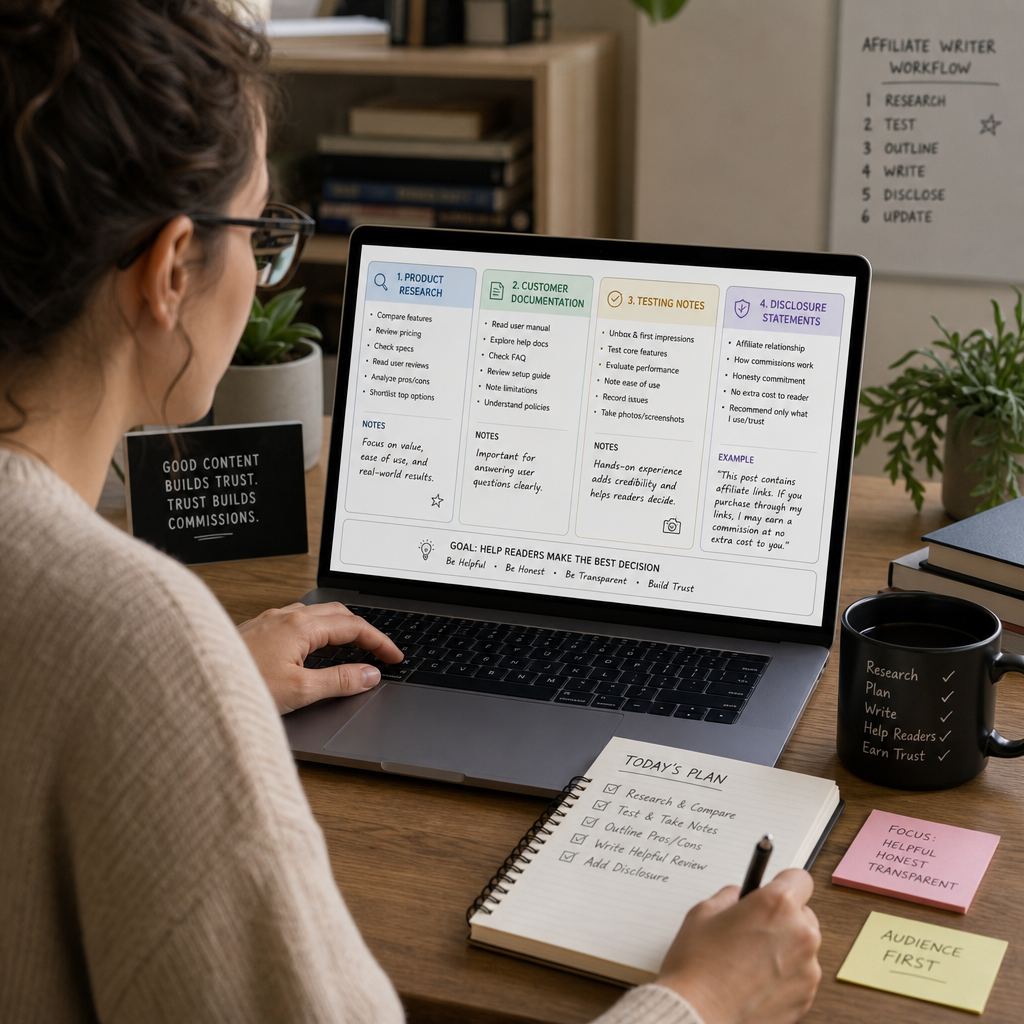
You Can Help Readers Without Pretending You Tested Everything
Affiliate writers do not need to own every product they mention. They do, however, need to tell readers what they personally know, what they researched, what remains uncertain, and why the recommendation deserves attention.
Affiliate disclosure: This guide contains a Wealthy Affiliate link near the end. OnlineAffiliate.net may earn compensation if you later purchase through that link, at no additional cost to you. The research and disclosure principles in this article apply regardless of the platform, tools, or affiliate programs you use.
Quick Answer: Can You Review a Product You Haven’t Used?
You should not present a product article as a firsthand review when you have not personally used or tested the product.
You can still create a useful research-based buyer’s guide, feature analysis, product overview, or comparison by studying reliable sources, checking important claims, explaining your method, acknowledging limitations, and clearly stating that the conclusions are not based on personal testing.
One of the most uncomfortable questions in affiliate marketing is also one of the most important:
Must you buy every product before you are allowed to write about it?
For most independent publishers, buying every product is unrealistic. Software plans, home appliances, business platforms, specialty equipment, subscriptions, and premium tools can cost hundreds or thousands of dollars. A new affiliate website may not have the budget, access, or physical space to test everything its readers are considering.
The solution is not to manufacture experience. The solution is to label the article honestly and make the research strong enough to stand on its own.
Firsthand Review vs. Research-Based Buyer’s Guide
| Content Element | Firsthand Review | Research-Based Buyer’s Guide |
|---|---|---|
| Personal use | The writer personally used, tested, installed, joined, or evaluated the product. | The writer did not personally test every product and says so clearly. |
| Primary evidence | Original photos, measurements, screenshots, observations, test results, or usage notes. | Official documentation, manuals, policies, specifications, demonstrations, and carefully evaluated third-party evidence. |
| Appropriate claims | May discuss actual comfort, performance, workflow, reliability, or observed limitations. | Should focus on documented capabilities, comparison criteria, likely fit, known limitations, and unresolved questions. |
| Best label | Review, hands-on review, test, long-term review, or personal experience. | Buyer’s guide, research-based comparison, product overview, feature analysis, or options guide. |
| Main risk | Overgeneralizing from one person’s experience or too little testing. | Repeating manufacturer claims without verification or sounding more certain than the evidence allows. |
| Reader promise | “Here is what happened when I used it.” | “Here is what reliable evidence shows and what you should verify before buying.” |
Why the Label Matters
Readers commonly use the word “review” to mean almost any page about a product. That does not make every use of the label equally helpful.
A reader who sees “review” may reasonably expect direct experience. If the article is built entirely from product descriptions and other websites, the title can create an impression the evidence does not support.
A more accurate label does not weaken the article. It clarifies its value.
Use “Review”
Use this label when you have meaningful firsthand experience and can show what you evaluated, how you evaluated it, and what happened.
Use “Buyer’s Guide” or “Comparison”
Use these labels when your value comes from organizing evidence, comparing trade-offs, defining reader fit, and simplifying a difficult choice.
Do Not Publish Yet
Delay publication when you cannot verify essential claims, identify meaningful differences, explain limitations, or add value beyond the seller’s page.
The Seven-Step Research Method for Products You Have Not Tested
Define the Reader Before the Product
Identify the person, problem, budget, experience level, environment, and limitations behind the search.
A product cannot be “best” without a defined use case.
Start With Primary Sources
Examine official manuals, specification sheets, pricing pages, service terms, return policies, warranty documents, support pages, and product demonstrations.
Separate Facts From Marketing Claims
A published specification may be verifiable. Descriptions such as “effortless,” “professional,” “best,” or “revolutionary” are marketing judgments until supported by evidence.
Look for Independent Evidence
Study credible demonstrations, expert testing, user documentation, support discussions, and recurring complaint patterns.
Treat individual comments as signals to investigate, not automatic proof.
Compare Decision-Critical Differences
Focus on differences that could change the purchase: total cost, compatibility, learning curve, maintenance, limitations, support, cancellation terms, or upgrade requirements.
State What You Could Not Verify
Tell readers when long-term reliability, comfort, real-world speed, customer support quality, or another important factor remains uncertain.
Explain the Research Boundary
Include a short methodology note explaining whether you owned, tested, accessed, observed, or researched each product.
Update the Article
Recheck prices, features, availability, policies, affiliate links, and recommendation fit whenever the market changes.
A Disclosure You Can Adapt
The most useful disclosure explains both the financial relationship and the evidence behind the article.
Adapt the wording to the actual article. Do not claim independent research unless you performed it, and do not use a standard disclosure to disguise weak sourcing.
Apply the OnlineAffiliate.net P.R.O.O.F. Content Test™
A research-based comparison can be valuable when it passes the same reader-first test as any other OnlineAffiliate.net content.
What Makes a Research-Based Comparison Worth Publishing?
A useful comparison should do more than place specifications beside one another. Readers can often find basic specifications on a seller’s page or obtain a quick summary from an AI answer.
Your article earns attention by interpreting the information:
- Which differences will affect a beginner most?
- Which features require an additional purchase?
- Which option has the lower total cost rather than the lowest initial price?
- Which buyer may struggle with setup, maintenance, or compatibility?
- Which attractive feature matters less in ordinary use?
- Which claims remain uncertain without direct testing?
- When should the reader buy neither product?
Those questions turn a product summary into decision support.
Claims You Should Avoid Without Firsthand Evidence
- “This is the most comfortable option.”
- “It worked flawlessly during my testing.”
- “The customer support is excellent.”
- “This product lasts for years.”
- “You will get better results with this model.”
- “This is the best product on the market.”
You may sometimes report that a company claims something or that a particular test found something. Attribute the claim accurately, link to the source where useful, and avoid turning someone else’s observation into your personal conclusion.
When You Should Buy or Test the Product
Research-based coverage is not a permanent substitute for firsthand experience in every situation.
Direct testing becomes especially valuable when the buying decision depends on:
- Comfort, sound, taste, feel, fit, or appearance
- Real-world speed or performance
- Installation difficulty
- Software usability and workflow
- Durability and maintenance
- Compatibility with other products
- Results that differ significantly from published specifications
Begin where your evidence is strongest. A research-based guide can later become a firsthand review after you obtain meaningful access and update the article with original evidence.
Research-Based Article Readiness Check
Complete these steps before publishing. Progress is saved in this browser.
0 of 6 publishing checks completed
Four-Question Knowledge Check
Test whether you can distinguish honest buyer guidance from implied firsthand experience.
Continue Building Trustworthy Affiliate Content
Primary Guidance for Further Reading
Frequently Asked Questions
Is it illegal to review a product you have not used?
The central issue is whether the article is truthful and nonmisleading. Do not claim personal use, testing, results, or experience that did not occur. Clearly describe the evidence and disclose material affiliate or brand relationships.
Should I call the article a review if I only researched the product?
A label such as research-based buyer’s guide, product comparison, feature analysis, or product overview usually communicates the evidence more accurately. Readers often interpret “review” as a sign of firsthand use.
Can customer reviews be used as research?
Customer comments can reveal recurring questions and possible problems, but individual reviews are not automatically reliable. Look for consistent patterns, compare them with official documentation and independent evidence, and avoid repeating unverified allegations as facts.
Can AI write a product comparison for me?
AI can help organize criteria, generate questions, or structure a draft, but it should not be treated as the source of truth. Verify specifications, prices, policies, and claims through current primary sources, then add your own evaluation and reader-focused judgment.
How can I add original value without owning the product?
Define a specific reader, compare total costs, uncover compatibility issues, explain hidden requirements, identify poor-fit users, reconcile conflicting information, and show what remains uncertain. Original value can come from analysis as well as direct testing.
Should affiliate links use a sponsored attribute?
Google recommends qualifying paid and affiliate relationships with an appropriate attribute such as rel=”sponsored.” The relationship should also be explained clearly to readers through a visible disclosure.
Credibility Begins Where Pretending Ends
You do not have to test every product to help a reader make a better decision. You do have to be honest about your evidence, careful with your claims, useful in your analysis, and willing to say when the available information is not enough.
The Wealthy Affiliate button is an affiliate link. OnlineAffiliate.net may receive compensation if you later purchase through it. Your price is not increased. Training, tools, hosting, and support do not guarantee traffic, rankings, commissions, or income.
