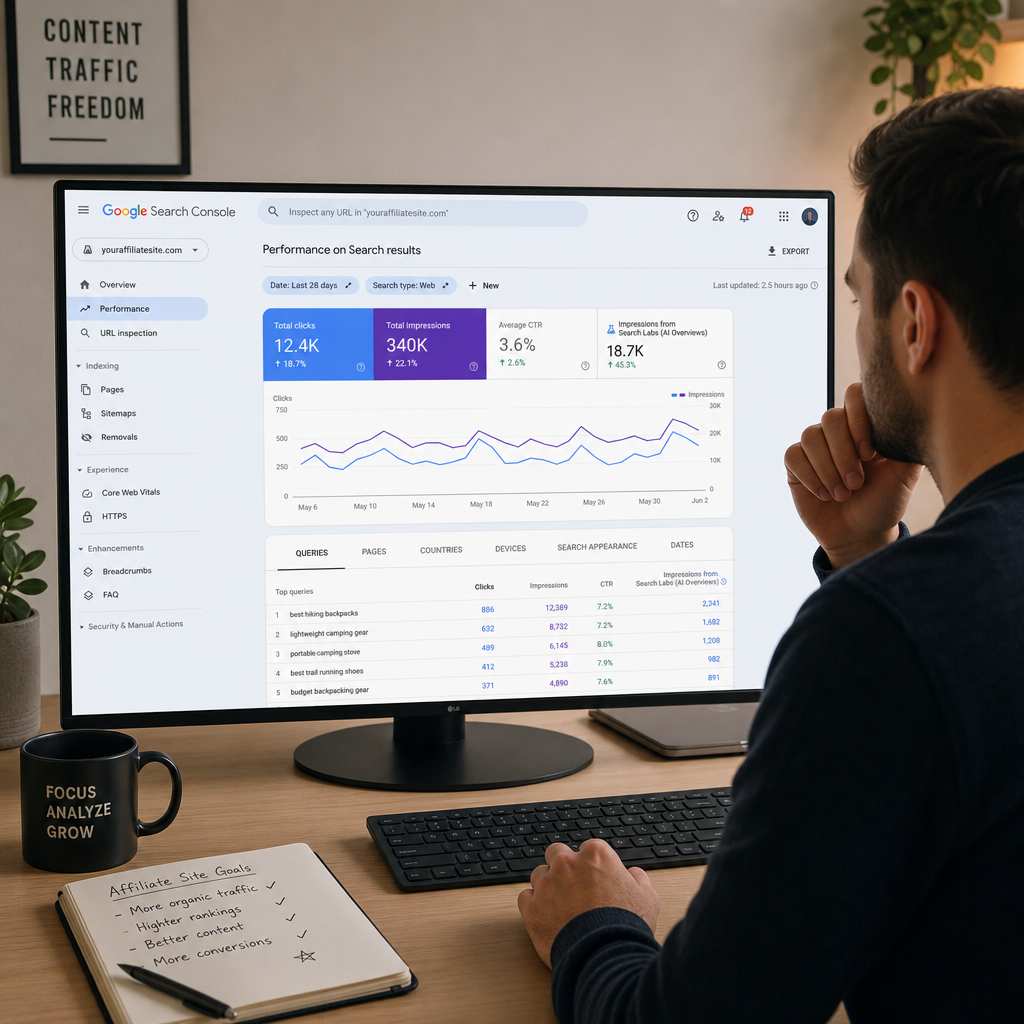
AI Search Visibility Is No Longer Completely Invisible
Google Search Console has begun showing eligible website owners which pages receive impressions in AI Overviews, AI Mode, and generative Discover experiences. The report is useful—but only when you understand what the numbers mean and what they cannot prove.
Affiliate disclosure: This guide includes a Wealthy Affiliate link near the end. OnlineAffiliate.net may earn compensation if you later purchase through that link, at no additional cost to you. Search Console itself is a free Google service, and no paid platform can guarantee inclusion in AI Overviews, AI Mode, Discover, or standard search results.
Quick Answer: What Is the Generative AI Performance Report?
Google Search Console’s Generative AI performance report shows how often links to your website appeared in supported generative AI features.
The Search version currently includes impressions from AI Overviews and AI Mode. A separate Discover version reports eligible impressions from generative AI features in Google Discover. Access is still rolling out, and some websites may not see either report yet.
Affiliate publishers have spent the last several years asking a difficult question: Is AI search helping people discover my content, or answering their questions before they visit?
Search Console’s new reports do not provide a complete answer. They do, however, provide a useful first signal.
Instead of guessing whether a page appears in AI-generated search experiences, eligible site owners can begin identifying which canonical URLs are earning impressions, where those impressions originate, and whether visibility is increasing or declining over time.
Search Report vs. Discover Report
| Report Element | Generative AI Report for Search | Generative AI Report for Discover |
|---|---|---|
| Where content appears | Supported generative AI features in Google Search. | Supported generative AI experiences inside Google Discover. |
| Current included features | AI Overviews and AI Mode. | Generative AI features displayed in the Discover feed. |
| Main metric | Impressions for links shown in supported Search AI features. | Impressions when a qualifying result is scrolled into view in Discover. |
| Available dimensions | Pages, countries, dates, and devices. | Pages, countries, and dates. |
| Best use | Identify pages Google selects for AI-supported questions and comparisons. | Identify articles gaining visual, topical, or interest-driven exposure. |
| Important limitation | An impression does not prove a visit, conversion, ranking, or recommendation. | Discover visibility is personalized and may change quickly. |
What Affiliate Site Owners Should Track
Pages Earning Their First Impressions
Look for pages that begin appearing after an update, new comparison, clearer answer, stronger firsthand evidence, or improved internal linking.
Pages With Sustained Visibility
A single spike may be temporary. Repeated impressions across several weeks are more useful for identifying durable topics and formats.
Countries and Devices
Check whether visibility comes from the audience your article was written for and whether mobile users dominate the exposure.
Content Type
Note whether comparisons, definitions, tutorials, troubleshooting guides, experience-based articles, or product-fit pages earn the most impressions.
Changes After Meaningful Updates
Record when you improve evidence, clarify an answer, add an original example, update a recommendation, or repair an outdated page.
Business Relevance
A page with fewer impressions may still be more valuable when it reaches a well-matched reader who needs a specific decision answered.
What the Report Does Not Tell You
Early access to a new metric can create false confidence. Avoid reading more into the report than it actually shows.
- It does not reveal every prompt or query that triggered the result.
- It does not prove that an AI-generated answer endorsed your product recommendation.
- It does not guarantee clicks, commissions, subscribers, or rankings.
- It does not show data from active Search Labs experiments.
- It does not mean every impression came from a high-intent buyer.
- It does not replace standard Search, Discover, analytics, or conversion data.
A Simple Monthly Review Workflow
- Open the report: Check whether your verified Search Console property has received access.
- Choose a useful date range: Begin with 28 days, then compare it with the previous period when enough data exists.
- Sort by page: Identify the URLs receiving the most and fewest generative AI impressions.
- Group the winners: Note the topic, format, search intent, evidence level, and type of reader decision each page supports.
- Review the page manually: Confirm that the answer, affiliate disclosure, links, claims, screenshots, and recommendations remain accurate.
- Improve one weakness: Add a clearer explanation, original example, comparison criterion, limitation, or reader-fit statement.
- Record the change: Measure the next period without assuming that one edit caused every increase or decline.
How to Improve a Page Without Chasing AI-Search Tricks
Google’s current guidance does not require a special AI-writing format, tiny content chunks, an AI-specific text file, or a separate page for every possible question.
The more durable approach is also the more useful one:
- Answer the main question early and accurately.
- Add experience, examples, research, or analysis that cannot be copied from a generic summary.
- Use headings that help readers move through the decision.
- Explain who a recommendation fits and who should skip it.
- Use high-quality, relevant images with descriptive ALT text.
- Keep affiliate disclosures visible and understandable.
- Maintain links, pricing references, feature claims, and comparison criteria.
- Connect the page to relevant supporting articles instead of publishing isolated posts.
Use the OnlineAffiliate.net P.R.O.O.F. Content Test™
Before trying to increase AI visibility, make sure the page deserves more visibility.
How to Interpret Four Common Data Patterns
| Pattern | Possible Meaning | Reader-First Response |
|---|---|---|
| Impressions rising steadily | The page may be matching more supported AI-search situations. | Protect what works, verify accuracy, and strengthen the next step. |
| High impressions but weak engagement | The topic may be visible, but the title, snippet, or page experience may not earn the visit. | Clarify the page promise and make the content more distinct. |
| Impressions fall after a spike | The exposure may have been temporary, seasonal, news-driven, or experimental. | Review the longer trend before making major changes. |
| No report or no data | Rollout may not have reached the property, or the site may lack enough eligible impressions. | Continue improving the site rather than forcing an AI-specific rewrite. |
Monthly AI Visibility Review
Mark each step as you complete it. Progress is saved in this browser.
0 of 6 review steps completed
Four-Question Knowledge Check
Test whether you can use the report without turning impressions into misleading conclusions.
Continue Building a Stronger Affiliate Website
Official Guidance and Documentation
Frequently Asked Questions
Why can’t I see the Generative AI performance report?
Google is rolling the reports out to a subset of website owners. A property may also lack enough eligible generative AI impressions to display data. Missing access does not automatically indicate a penalty or technical problem.
Does the report show AI Overview clicks?
The dedicated report focuses on impressions—how often links to the site appeared in supported generative AI features. Use the broader Search Console and analytics reports to evaluate traffic and engagement alongside those impressions.
Can I see the exact AI prompts that showed my page?
The current report documentation describes page, country, date, and device dimensions for Search, but it does not provide a complete list of the exact prompts or conversations that caused every impression.
Do I need special AEO or GEO markup?
Google says there is no special structured data or AI-specific text file required for generative AI visibility. Standard SEO, crawlability, clear site structure, useful content, and good page experience remain the foundation.
Should I rewrite articles that receive no AI impressions?
Not solely because the report shows zero impressions. First consider whether the page serves its intended audience, earns standard search traffic, supports another article, or answers a valuable low-volume question. Improve genuine weaknesses rather than chasing one metric.
Can a paid affiliate platform increase AI visibility?
A platform can provide training, research tools, hosting, or workflow support, but it cannot guarantee inclusion in Google’s generative AI features. Visibility depends on many factors controlled by Google’s systems and the quality and relevance of the website.
Measure the Signal, Then Improve the Experience
The new report gives affiliate publishers a clearer view of where their content appears. Use that visibility to find useful patterns—not to chase shortcuts. The strongest response is still a better answer, better evidence, clearer reader fit, and a more trustworthy recommendation.
The Wealthy Affiliate button is an affiliate link. OnlineAffiliate.net may receive compensation if you later purchase through it. Your price is not increased. Training, tools, hosting, and support do not guarantee traffic, AI visibility, rankings, commissions, or income.
