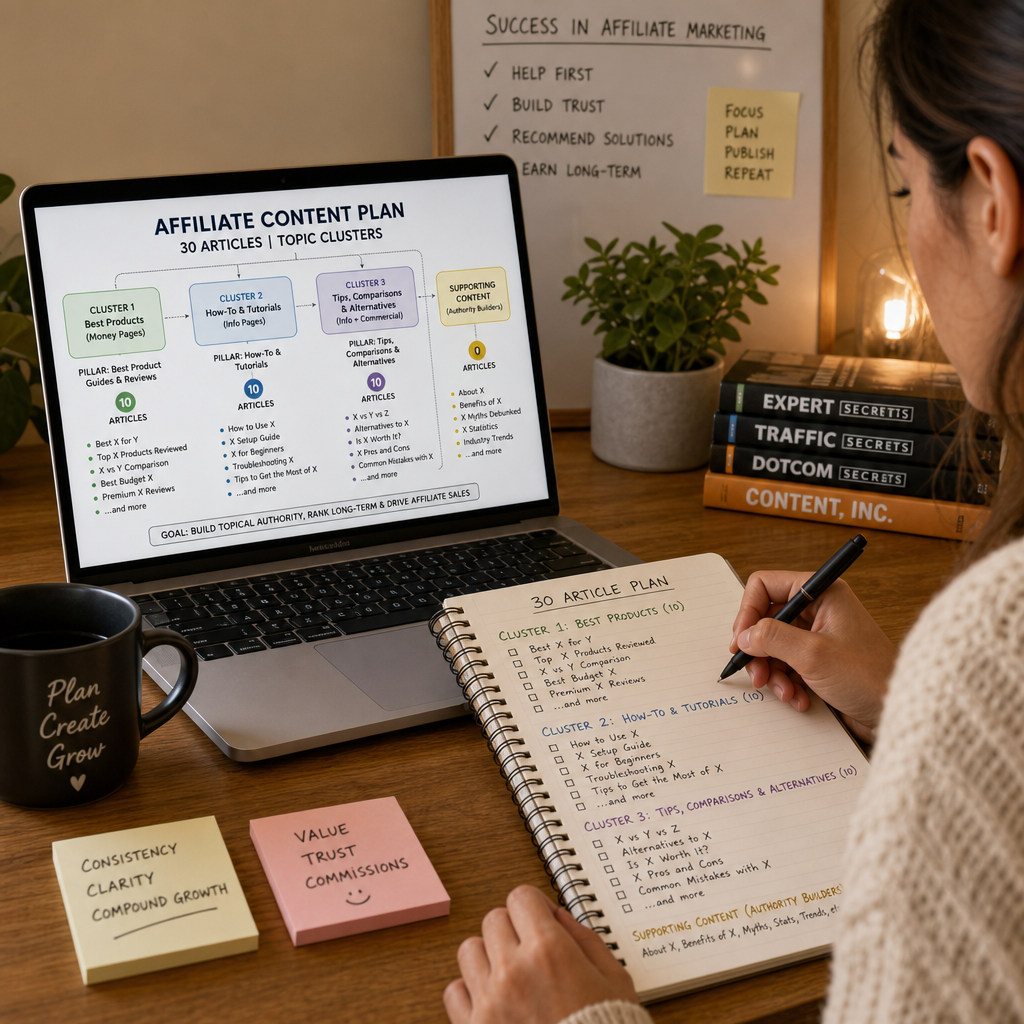
Five Articles Are a Beginning—not a Verdict
Many affiliate websites are abandoned before they contain enough useful, connected content to reveal what is working. The 30-article rule gives beginners a more realistic checkpoint: build a helpful foundation first, then evaluate the evidence.
Quick Answer: Is 30 Articles a Magic Ranking Number?
No. Thirty is not a guaranteed traffic threshold, a search-engine requirement, or a promise of affiliate income. It is a practical publishing checkpoint.
By the time you have created 30 closely related, genuinely helpful articles, you should have more internal-linking opportunities, more reader entry points, a clearer understanding of your niche, and enough real work to judge what deserves improvement.
Most beginners do not fail because they chose a terrible niche. Many fail because they judge the entire business after publishing a handful of disconnected pages.
One post targets a broad keyword. Another reviews a product. A third talks about something only loosely related. Traffic stays quiet, commissions do not appear, and the website begins to feel like proof that affiliate marketing does not work.
The problem may not be the business model. The website may simply be too incomplete to serve its intended reader well.
Why Use 30 Articles as Your First Meaningful Checkpoint?
The number is large enough to encourage commitment but small enough to remain understandable. It pushes you beyond the fragile stage where every post stands alone.
A connected library of 30 articles can begin to demonstrate:
- A consistent subject and intended audience
- Several ways for readers to discover your website
- Natural paths between beginner, problem-solving, and decision content
- Opportunities to strengthen older pages with internal links
- Enough publishing experience to identify weak topics and stronger ones
- A more useful balance between education and monetization
None of those benefits requires every article to rank. The early goal is to create a useful body of work and learn from it.
Five Disconnected Posts vs. a 30-Article Resource
| Area | Five Disconnected Posts | Thirty Connected Articles |
|---|---|---|
| Site focus | The niche may still appear broad, mixed, or uncertain. | The intended reader and recurring subject become easier to recognize. |
| Reader journey | A visitor may read one page and reach a dead end. | Related guides can lead readers from a basic question to a useful next step. |
| Internal links | Few relevant pages are available to connect. | Articles can support one another through contextual links. |
| Monetization | Product links can feel premature or forced. | Recommendations can appear where they naturally help a decision. |
| Learning | There is too little evidence to see useful patterns. | You can compare topics, formats, impressions, clicks, and reader behavior. |
| Improvement | Beginners often react by changing niches or redesigning the site. | You have enough material to update, combine, expand, and strengthen strategically. |
A Simple Structure for Your First 30 Articles
Do not treat the first 30 posts as 30 unrelated attempts to attract traffic. Organize them around the questions one audience asks before, during, and after making a decision.
Build the Foundation
Explain the niche, introduce the essential concepts, and answer the questions a complete beginner asks first.
- What the topic means
- Who it is for
- How to begin
- Common terms and mistakes
- What realistic progress looks like
Solve Recurring Problems
Create practical articles that help the reader overcome confusion, avoid mistakes, and complete specific tasks.
- Step-by-step tutorials
- Troubleshooting guides
- Checklists and planning tools
- Frequently asked questions
- Examples and realistic scenarios
Support Better Decisions
Add comparisons, reviews, alternatives, and buying guidance only after the educational foundation has begun earning trust.
- Product or platform comparisons
- Best-fit and poor-fit readers
- Costs and limitations
- Alternatives
- Transparent recommendations
Need help choosing a focused subject before planning the 30 posts? Start with the 10-minute affiliate niche test .
Think in Content Clusters, Not a Random List
A content cluster is simply a group of articles that helps one reader understand a larger subject. You do not need complicated software to build one.
Begin with three broad questions your audience repeatedly asks. Turn each question into a central guide. Then create several supporting articles that answer the smaller questions inside it.
This structure is more useful than publishing 30 variations of “best affiliate program” because it helps readers learn, act, compare, and move forward in a logical order.
For a deeper content-quality framework, read The New Era of Content: How to Write Blog Posts That Actually Rank in 2026 .
Where Should Affiliate Links Appear?
An affiliate link should improve the answer—not interrupt it.
Some of your first 30 articles may not need a commercial link at all. Informational articles can build understanding, attract the right reader, and lead naturally to a later comparison or review.
Before adding an affiliate recommendation, ask:
- Does this product or service solve the problem discussed on this page?
- Have I explained who it fits and who may not need it?
- Have I included meaningful limitations or alternatives?
- Is the affiliate relationship disclosed clearly?
- Would this page still be useful if the reader never clicked the link?
If the answer to the final question is no, strengthen the article before increasing its number of calls to action.
What Should You Do After Article 30?
Do not immediately begin another batch without reviewing what you have learned. Article 30 is a checkpoint—not a finish line.
Look for:
- Pages receiving impressions but few clicks
- Questions that deserve clearer or more complete answers
- Articles competing with one another for the same purpose
- Older posts that need updated examples or stronger introductions
- Pages that should link to one another but currently do not
- Topics readers engage with more than expected
- Commercial pages that need better supporting education
You may decide to publish articles 31 through 40. You may also discover that improving ten existing pages is more valuable than adding ten new ones.
Your 30-Article Momentum Check
Mark the steps you have already completed. Your progress is saved in this browser.
0 of 4 planning steps completed
Four-Question Knowledge Check
Test whether you are ready to use the 30-article rule as a strategy rather than another publishing quota.
Continue Building Your Affiliate Foundation
Frequently Asked Questions
Are 30 articles enough to earn affiliate income?
Not necessarily. Thirty articles do not guarantee traffic, rankings, clicks, or income. The number is best used as a practical checkpoint for building useful content, creating internal links, and gathering enough evidence to make better decisions.
How quickly should a beginner publish 30 articles?
Choose a pace that allows you to research, write, verify, edit, and connect each page properly. Publishing one or two strong articles a week is often more sustainable than rushing through a large batch of thin posts. Quality and continuity matter more than finishing on an arbitrary date.
Should all 30 articles contain affiliate links?
No. Some articles should educate, answer basic questions, or solve a problem without pushing a product. Add an affiliate recommendation when it genuinely supports the reader’s next decision, and disclose the relationship clearly.
Can AI help create the first 30 articles?
AI can assist with brainstorming, outlines, organization, editing, and identifying questions to investigate. The publisher remains responsible for accuracy, originality, useful examples, source verification, disclosures, and the final recommendation.
What if the website still has very little traffic after 30 posts?
Review the niche focus, search intent, article quality, indexing, internal links, page experience, competition, and whether the content adds anything meaningfully useful. Low traffic is a signal to investigate and improve—not automatic proof that the entire niche should be abandoned.
Build the Resource Before Judging the Business
Your first five articles show that you started. Your first 30 can begin showing what the website is capable of becoming. Choose one reader, answer connected questions, recommend ethically, and improve from real evidence.
Affiliate disclosure: The guided-platform button is an affiliate link. OnlineAffiliate.net may earn a commission if you later purchase through it, at no additional cost to you. Training, tools, and platforms do not guarantee traffic or income.
Editorial note: This article presents the 30-article rule as a planning framework, not a search-engine threshold or earnings promise. Results vary according to the niche, competition, content quality, originality, publishing consistency, promotion, technical setup, reader trust, and market conditions. Review the full affiliate disclosure.
