Affiliate Content Strategy
The recommendation worked. The reader opened the tool—and met an unfamiliar dashboard, ten possible directions, and no obvious first move. A useful affiliate site should not leave them there.

Quick answer
What Is a First-Result Guide?
A first-result guide is post-purchase content that helps a specific reader complete one useful, visible task with a product or service. It is narrower than a full tutorial and more purposeful than a feature tour. The guide defines what “done” looks like, includes only the steps required to reach it, warns about the likeliest snag, and shows the reader what to do next.
The latest OnlineAffiliate.net article showed what to publish after the affiliate click: setup help, first-use guidance, troubleshooting, better-use content, and honest reassessment. The best next move is not to create all five kinds at once. It is to solve the first meaningful problem a suitable user faces.
That problem is often not, “What features are included?” The sales page already answered that. The real question is, “What should I do first so I know this tool can help me?”
The Purchase Solved One Problem—and Created Another
Before choosing, the reader had a comparison problem. After choosing, the reader has an execution problem.
Imagine someone joins a website-building platform because they want to begin an affiliate site. They enter the dashboard and see niche research, training, website setup, content tools, community discussions, hosting controls, and upgrade options. A 40-minute tour may explain every menu. It can still leave the beginner unsure what to do during the next 20 minutes.
A first-result guide reduces that decision load. It chooses one honest outcome such as:
- Define one audience and one recurring problem.
- Create the basic structure for one useful page.
- Connect a product to its app without enabling every automation.
- Complete a safety or privacy setting before normal use.
- Export one test file and confirm that it opens correctly.
The outcome does not have to be impressive. It has to be observable. “Understand the platform” is vague. “Publish a draft page with one reader, one problem, and one next step” can be checked.
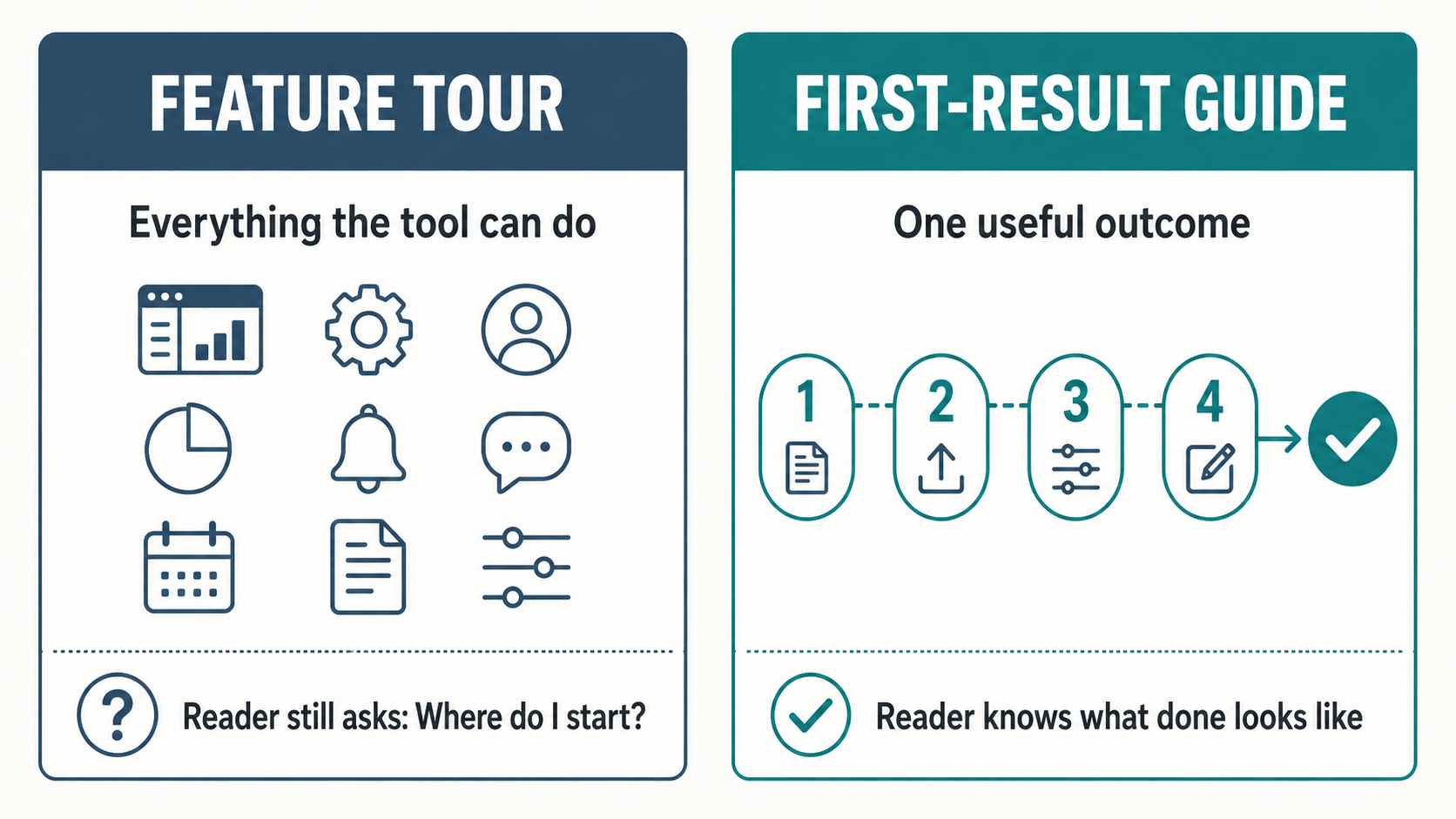
Feature Tour vs. First-Result Guide
| Decision | Feature tour | First-result guide |
|---|---|---|
| Main job | Show what the product can do. | Help one reader do one useful thing. |
| Starting point | The product menu or feature list. | The reader’s immediate post-decision problem. |
| Scope | Broad; often covers every major area. | Narrow; includes only what the first outcome requires. |
| Definition of done | The tour reaches the last feature. | The reader can see, save, test, or verify a result. |
| Optional features | Often introduced immediately. | Deferred unless they prevent or improve the result. |
| Best next link | Another feature explanation. | A relevant improvement, troubleshooting, or reassessment step. |
A product tour is not automatically bad. It can help readers learn the territory. The mistake is treating orientation as completion. If the reader finishes the article and still cannot tell whether anything worked, the content stopped too early.
Use Five Decisions to Build the Guide
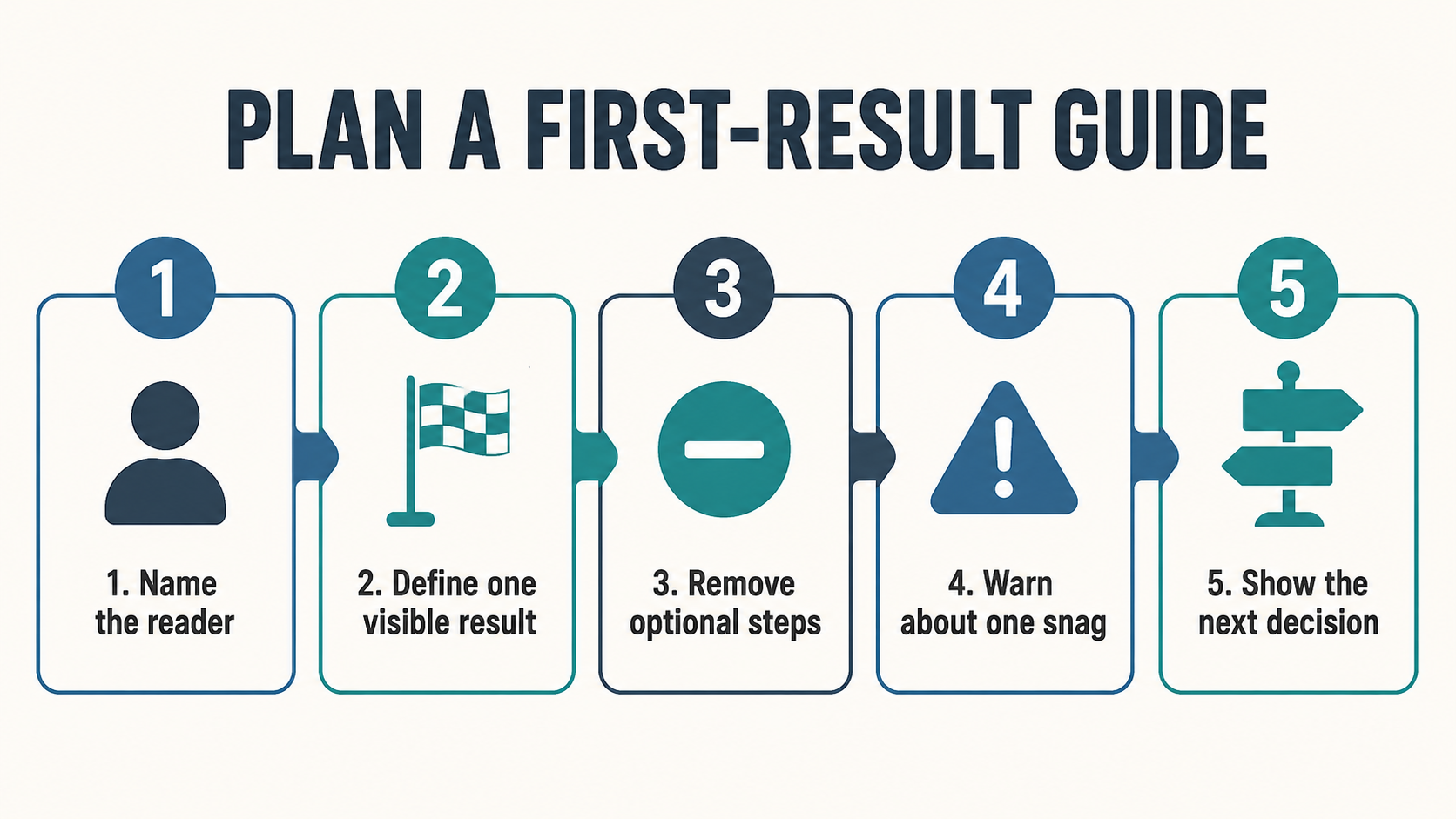
The first-result article should feel simple to the reader because the publisher made the hard decisions in advance. Use this sequence before drafting.
1Name the exact reader
“New users” is rarely specific enough. Is this a first-time site owner, a writer moving from paper notes, or a small-business owner with an existing website? The correct first result changes with the reader’s starting knowledge and available tools.
2Define one visible result
Choose an outcome the reader can recognize without trusting a promise. A completed settings check, a saved draft, a connected account, or a successful test export is stronger than “get better results.”
3Remove optional steps
Every extra choice creates another place to stall. Keep prerequisites, required settings, and the shortest safe path. Move advanced customization, add-ons, and efficiency tricks into later content.
4Warn about one likely snag
Do not turn the article into a troubleshooting encyclopedia. Explain the mistake most likely to block this result, what it looks like, and whether the reader can fix it or should use official support.
5Show the next decision
Once the result exists, help the reader choose what follows: repeat the process, improve it, solve a related limitation, pause, or reassess the product. The next step should serve the task—not force another sale.
Keep the promise small
The first result proves that the reader understands one workflow. It does not prove future traffic, rankings, commissions, profitability, or business success. Separate a completed task from an uncertain outcome.
Write for the Moment the Reader Actually Gets Stuck
A strong opening does not repeat the product description. It mirrors the moment that brought the reader back to search:
Weak opening
“This powerful platform includes many tools that can help you build an online business.”
Stronger opening
“You opened the dashboard and found five places you could begin. For this first session, ignore four of them. Your only goal is to define one reader, one recurring problem, and the page that will answer it.”
The second version gives the reader permission to ignore distractions. It also establishes a completion test. That is more useful than calling the tool powerful.
Show the starting condition
State what the reader should already have before step one. That may be an active account, a verified email address, a browser, a file format, a measurement, or a decision from an earlier guide. If a prerequisite is optional, label it optional.
Use steps that describe actions
“Explore the dashboard” is not a step. “Open the Site menu and confirm which domain is active” is. Use verbs, expected screen labels, and brief reasons when a setting has a trade-off.
Include a checkpoint after each meaningful action
A checkpoint answers, “How do I know that worked?” It may be a confirmation message, a saved status, a visible preview, a new file, or a specific value. When interfaces change, outcome-based checkpoints age better than long descriptions of every button around them.
End with proof—not applause
Instead of “Congratulations, you are on your way to success,” tell the reader what now exists and what remains uncertain. For example: “You now have a saved outline for one reader problem. It is not proof that the article will rank or earn a commission. It is proof that your first page has a defined job.”
Support boundary
Your guide can explain a general workflow. Account access, billing, refunds, private data, security incidents, outages, and product-specific errors usually belong with the merchant’s current support team. Do not imply that an independent affiliate publisher can see or change a reader’s account.
What Should You Leave Out?
A first-result guide becomes more useful when it refuses to become the complete manual.
- Every feature: Mention only the features needed for this result.
- Every audience: If two readers need different starting paths, separate them clearly or write different guides.
- Speculative outcomes: Do not turn a completed setup into a forecast of traffic, income, health, or performance.
- Unverified shortcuts: A faster path is not better if it bypasses privacy, safety, disclosure, or required settings.
- Premature upgrades: Do not introduce a paid tier merely because the article contains an affiliate link. Explain the limit that makes an upgrade relevant.
- Hidden exits: If the tool is clearly wrong for the reader, link to the original comparison, an alternative approach, or current cancellation information.
This restraint supports the site’s broader reader-first affiliate content path. It also follows Google’s published guidance to create content for an existing audience, add original value, and leave readers feeling they learned enough to move toward their goal. See Google’s people-first content guidance.
Build Your First-Result Guide Plan
Choose one recommendation and design the smallest useful guide that should follow it. Your entries stay in this browser when you select Save My Plan.
Run the Draft Through the P.R.O.O.F. Content Test™
The P.R.O.O.F. Content Test keeps the guide useful when a product tour or promotional rewrite would be easier to publish.
P — Purpose
Does the page complete one clear post-decision job?
R — Real Input
Are the steps based on current documentation, transparent experience, testing, or verified reader questions?
O — Original Insight
Does the guide explain what to ignore, why a choice matters, and where beginners commonly stall?
O — Outcome Evidence
Can the reader recognize a completed result without confusing it with a guaranteed business outcome?
F — Fit for Reader
Does the advice match the reader’s starting point, and does it allow a wrong-fit reader to pause or leave?
Refresh check
Have you dated interface-sensitive details and added the guide to your affiliate content maintenance calendar?
Where the Links Belong
The first-result guide should be easy to reach from the page that created the need for it.
- Link forward from the review or comparison. Near the verdict, tell suitable readers where to begin if they choose the product.
- Link back to the decision context. If a limitation appears during setup, let the reader revisit the original trade-offs.
- Link to official support at the boundary. Use current merchant documentation for billing, security, private account, and platform-status issues.
- Link to the next reader question. The destination may be a troubleshooting article, a better-use guide, an alternative, or no purchase at all.
Before adding a commercial button, use the site’s reader-intent test for affiliate links. A compensated link should improve the answer at the moment it appears. The Federal Trade Commission also advises making a material relationship obvious and placing the disclosure with the endorsement rather than relying only on a profile or separate page. Review the FTC’s disclosure guidance.
Affiliate disclosure: The Wealthy Affiliate link below is an affiliate link. If you later join or purchase through it, OnlineAffiliate.net may earn compensation at no additional cost to you. Training, tools, and hosting do not guarantee traffic, rankings, commissions, profitability, or income.
If a connected environment for training, website tools, research, hosting, and community support fits the way you want to learn, inspect the current free starting experience before paying. As reviewed August 17, 2026, Wealthy Affiliate’s official pricing page lists a free Starter plan with no credit card required, one limited website, 4,000 one-time AI credits, limited support for seven days, and Phase 1 strategy access. Features and limits can change, so verify the current plan before deciding.
Explore Wealthy Affiliate Free
Verify current plans and limits on the official pricing page, or read the site’s detailed Wealthy Affiliate review before upgrading.
Four-Question Knowledge Check
Check whether you can separate a useful first result from a product tour or promotional promise.
Frequently Asked Questions
Does every affiliate product need a first-result guide?
No. Create one when suitable users face a meaningful first-use decision that your independent guidance can clarify. For a simple product, the merchant’s instructions or one concise paragraph may be enough.
How long should a first-result guide be?
Use the length required to reach the result safely and clearly. There is no preferred word count. A narrow task may need 700 words; a setup with prerequisites, screenshots, and a meaningful trade-off may need more.
Should I include screenshots?
Use screenshots when interface location matters, but pair them with written instructions and outcome-based checkpoints. Date interface-sensitive images and review them whenever the product changes.
Can a first-result guide contain affiliate links?
Yes, when the link genuinely helps with the next decision and the relationship is clearly disclosed. The guide may be stronger without another commercial link if the reader already has what the task requires.
How is this different from onboarding?
Onboarding may cover an entire introduction sequence designed by the merchant. A first-result guide is an independent, narrow piece of content built around one reader, one useful outcome, and an honest next decision.
How often should I update the guide?
Review it whenever the interface, prerequisites, plan limits, support path, or expected completion checkpoint changes. Also revisit it when reader comments reveal a new recurring snag.
The Reader Should Leave With Something Real
A first-result guide does not need to show everything, sell anything new, or predict success. It needs to help the right reader complete one honest task and recognize the result.
Open the review or comparison page that currently attracts your most serious readers. Ask what a suitable user will see during the first session, where that person is most likely to stop, and what small result would make the next decision easier. That is your next post.
Fact-check note: Platform details were checked against Wealthy Affiliate’s official pricing page on August 17, 2026. Disclosure guidance comes from the U.S. Federal Trade Commission, and content-quality guidance comes from Google Search Central. Product features, interfaces, prices, and plan limits can change.

What First Result Do Your Readers Need?
Share the product category and the first place a new user gets stuck in the comments. If you already have a guide, tell us the visible result it helps readers complete. Your example may reveal the next useful post for another publisher.
Join the Conversation