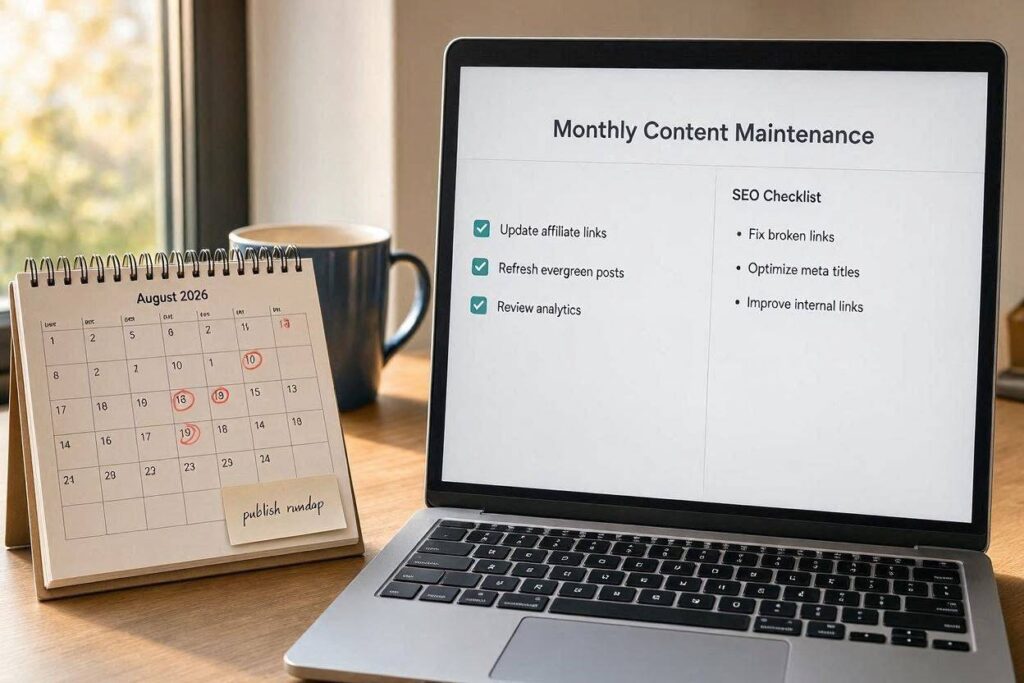
Your Affiliate Website Needs a Calendar, Not Another Panic Fix
Publishing content gets an affiliate website started. Maintaining that content is what keeps it useful. A simple monthly workflow helps you catch outdated recommendations, broken links, weak internal paths, and stale reader experience issues before they quietly damage trust.
Affiliate disclosure: This article may contain affiliate links. If you purchase or join through one of these links, OnlineAffiliate.net may earn a commission at no additional cost to you. Recommendations should always be evaluated for reader fit, usefulness, and realistic expectations.
“`Quick Answer: What Is an Affiliate Content Maintenance Calendar?
“`An affiliate content maintenance calendar is a simple monthly schedule for reviewing your most important pages, checking affiliate links, updating outdated information, improving internal links, refreshing FAQs, and making sure each recommendation still serves the reader.
The goal is not to change every article every month. The goal is to give your best and most sensitive pages regular attention before small issues turn into lost trust, broken clicks, or outdated advice.
“`Many new affiliate publishers treat content like a one-time task. They publish an article, add a few links, move on to the next topic, and hope the older page continues doing its job.
But every article becomes a living asset.
Products change. Programs change. Prices change. Search results change. Reader expectations change. Even your own understanding of the topic improves over time.
A monthly maintenance calendar turns all of that into a repeatable routine instead of an emergency cleanup.
Without a Calendar vs. With a Calendar
| Website Area | Without a Maintenance Calendar | With a Maintenance Calendar |
|---|---|---|
| Affiliate links | Broken or redirected links may remain unnoticed for months. | Important links are checked on a routine schedule. |
| Recommendations | Old product advice can stay live after better options appear. | Recommendations are reviewed for current reader fit. |
| Internal links | Newer supporting articles may never connect to older pages. | Readers are guided through a clearer learning path. |
| Search intent | The page may answer yesterday’s version of the question. | Headlines, quick answers, and FAQs can stay aligned with current needs. |
| Trust | Readers may notice stale claims before the publisher does. | The site shows care, accuracy, and ongoing attention. |
A Simple Four-Week Monthly Workflow
“`This schedule keeps maintenance manageable. Instead of trying to fix the entire website in one sitting, each week has one primary focus.
Review Your Best Content
Look at pages already receiving traffic, clicks, comments, or affiliate interest. These pages deserve the first attention because readers are already finding them.
Audit Affiliate Links
Test destinations, redirects, disclosures, product availability, tracking links, and merchant changes. Every click should deliver what the article promised.
Improve Reader Experience
Strengthen comparison sections, mobile readability, quick answers, internal links, and next steps. Small usability updates can make a page feel far more helpful.
Refresh Authority Signals
Update sources, examples, FAQs, screenshots, dates, and claims that depend on current information. Record what changed in your notes.
The Five Maintenance Habits That Matter Most
Keep Affiliate Links Honest
A working link is not automatically a useful link. Confirm that the destination still matches the recommendation, the surrounding copy, and the reader’s expectation.
Refresh Before Replacing
Many articles do not need a full rewrite. They need a clearer quick answer, a better comparison, updated facts, stronger internal links, or a more honest limitation.
Update Internal Links
Every important article should help readers reach the next useful step. Add links to newer supporting articles when they clarify a decision or answer a natural follow-up question.
Review Search Intent
Ask what today’s visitor wants from the page. If the question has shifted, the article’s introduction, headings, comparison, and FAQs may need to shift with it.
Protect Reader Trust
Do not update only to increase clicks. Update to make the page more accurate, readable, fair, current, and useful for the person making a decision.
Document What Changed
Keep a simple note with the page URL, review date, what changed, and what needs future attention. Your future self will be grateful.
Which Pages Should You Review First?
Not every page deserves the same monthly attention. Start with pages where accuracy, trust, or revenue potential matters most.
- Pages receiving the most traffic
- Pages with affiliate buttons or product recommendations
- Reviews, comparisons, and beginner guides
- Articles with pricing, platform terms, or commission information
- Posts that mention income claims, success stories, or results
- Older posts that still receive impressions or clicks
- Pages that support your main internal-link structure
Low-traffic articles can still matter, but your first maintenance hours should protect the pages readers already use.
What to Check During a Monthly Review
| Review Area | What to Check | Reader-First Fix |
|---|---|---|
| Quick answer | Does the page answer the main question early? | Add a concise answer before deeper explanation. |
| Affiliate recommendation | Does the product, platform, or program still fit the reader? | Update, qualify, replace, or remove the recommendation. |
| Disclosure | Is the affiliate relationship clear before or near the commercial link? | Add plain-language disclosure where the reader needs it. |
| Internal links | Are there newer supporting articles that help the reader continue? | Add natural links to relevant next-step resources. |
| FAQs | Do the FAQs answer real objections and follow-up questions? | Replace filler questions with practical decision support. |
| Mobile readability | Are tables, buttons, contrast, and spacing easy to use on a phone? | Improve layout, spacing, font contrast, and button clarity. |
Use the OnlineAffiliate.net P.R.O.O.F. Content Test™
“`Before calling a page “updated,” run it through the same reader-first standard that guides strong affiliate content.
A Practical Monthly Maintenance Routine
- Pick five priority URLs. Choose pages with traffic, affiliate links, or important reader decisions.
- Open each page on mobile. Look for cramped text, unclear buttons, hard-to-read tables, or weak spacing.
- Test every commercial link. Confirm the destination, disclosure, product fit, and tracking path.
- Update one stale section. Refresh an example, FAQ, comparison point, quick answer, or internal link.
- Check supporting content. Link to newer articles when they naturally help the reader continue.
- Record the update. Note the date, what changed, and what should be checked next time.
This is intentionally simple. A maintenance plan that you can repeat beats a complicated spreadsheet that gets ignored after one month.
Monthly Affiliate Maintenance Check
“`Mark each step as you complete it. Progress is saved in this browser.
0 of 6 maintenance checks completed
“`Four-Question Knowledge Check
“`Test whether your maintenance routine is focused on reader value instead of busywork.
“`Continue Building a Better Affiliate Website
Frequently Asked Questions
“`How often should affiliate content be updated?
Review important commercial pages monthly and perform deeper updates at least twice a year. Pages with pricing, product recommendations, affiliate links, or platform details usually need more frequent attention than evergreen educational articles.
Should every article be refreshed monthly?
No. Prioritize pages that already receive traffic, contain affiliate recommendations, include time-sensitive information, or support the site’s main content strategy.
Can updating content improve rankings?
Meaningful updates that improve accuracy, usability, completeness, and relevance may support better performance, but no content update guarantees higher rankings, traffic, clicks, or commissions.
What should I check first during maintenance?
Start with broken affiliate links, outdated recommendations, stale facts, unclear disclosures, and missing internal links. These are often the issues that most directly affect reader trust.
Should I update the visible date after every edit?
Update the visible date only when the page has received a meaningful review or improvement. A typo fix or minor formatting change usually does not justify presenting the article as freshly updated.
What if a page no longer has a good affiliate recommendation?
Preserve the useful education and remove the commercial link if no suitable replacement exists. A noncommercial article that helps the reader is better than a forced affiliate recommendation.
Maintain the Trust You Worked Hard to Earn
“`The strongest affiliate websites are not always the ones publishing the most articles. They are often the ones that consistently improve what they have already built. Use the calendar, protect your best pages, and make every update serve the reader first.
The Wealthy Affiliate button is an affiliate link. OnlineAffiliate.net may receive compensation if you later join through it. Your price is not increased. Training, hosting, tools, support, and affiliate programs do not guarantee traffic, rankings, commissions, profitability, or income.
“`