Affiliate Content Strategy
A Reader Should Never Reach a Dead End
You can publish an excellent tutorial, a careful comparison, and an honest review—and still lose the reader between them. The problem is not always the quality of the individual posts. Sometimes the pages simply do not show people where to go next.
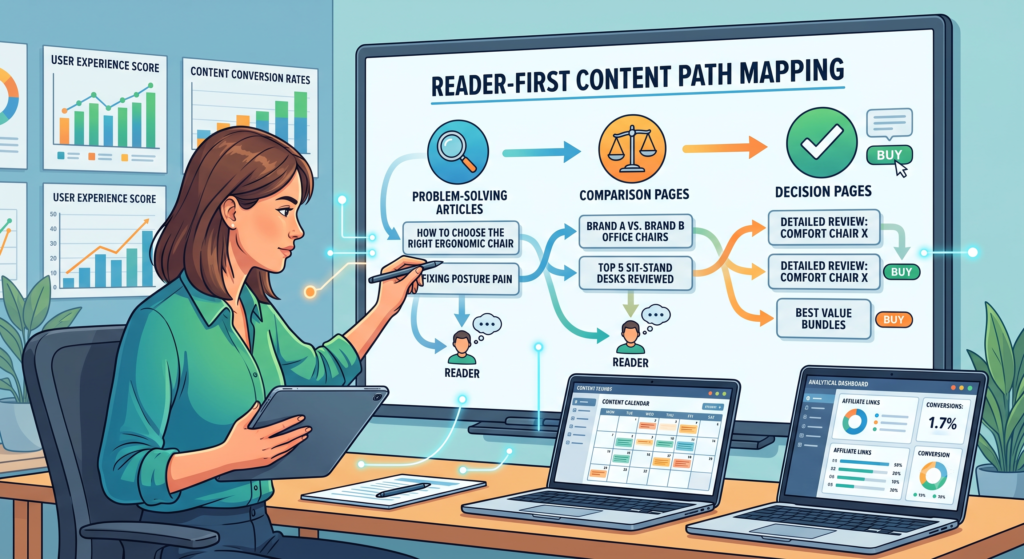
A reader-first affiliate content funnel connects related questions in the order people naturally ask them. It helps a beginner learn, compare, decide, and use the solution successfully without turning every page into a sales pitch.
What Is an Affiliate Content Funnel?
An affiliate content funnel is a connected group of pages that helps a specific reader move from an initial problem to the next useful decision. A strong path usually includes content for discovering the problem, understanding the options, evaluating trade-offs, taking an appropriate action, and succeeding after that action.
It is not a script for pushing every visitor toward the same product. Each internal link should answer the reader’s likely next question. Sometimes the best next step is a comparison, an official source, another tutorial, or the decision to buy nothing yet.
Why Good Affiliate Posts Still Underperform When They Work Alone
Imagine a visitor finds your article about choosing an affiliate niche. The guide helps, but the ending only says, “Leave a comment below.” The reader still does not know how to test the niche, plan the first articles, compare a DIY setup with a guided platform, or decide what to do this week.
The post answered the search query but abandoned the larger task.
That is how a website can accumulate dozens of useful pages while still feeling like a stack of separate documents. Searchers arrive through different doors, but few doors open into a coherent learning path.
Isolated Post Collection
- Every article tries to rank by itself.
- Calls to action repeat the same offer regardless of intent.
- Internal links are added because a keyword matches.
- Informational readers are sent directly to a signup page.
- Commercial pages must create trust from zero.
Reader-First Content Path
- Each page completes one clear job.
- The next step changes with the reader’s stage.
- Internal links answer a natural follow-up question.
- Comparisons appear when readers are ready to evaluate.
- Commercial pages inherit context from earlier help.
The Five-Stage Reader Path
Real journeys are not perfectly linear. A reader may enter at the comparison stage, return to an earlier explanation, or leave after solving the problem for free. These five stages are planning roles—not a promise that everyone will click through them in order.
Discover
Name the symptom, question, or missed opportunity in the reader’s own language.
Understand
Explain causes, terminology, choices, and what the reader should know before comparing products.
Evaluate
Compare approaches with fair criteria, visible trade-offs, and reader-fit conclusions.
Act
Help the right reader choose, join, buy, build, or deliberately wait—with clear expectations.
Succeed
Support setup, use, maintenance, troubleshooting, and reassessment after the decision.
Example: Turn One Beginner Question Into a Useful Content Path
Suppose the reader’s starting problem is, “I want to build an affiliate website, but I do not know where to begin.” A connected path could look like this:
-
1
Choose the audience. Start with the 10-minute affiliate niche test.Job: turn a broad interest into a defined reader and recurring problem.
-
2
Understand the build process. Continue with the four-step affiliate business plan.Job: show the work in a realistic order before discussing a platform.
-
3
Evaluate the setup choice. Use the honest comparison-table framework to compare DIY tools with guided options.Job: make costs, control, support, and limitations comparable.
-
4
Investigate a possible fit. Read the current Wealthy Affiliate review if a connected training-and-website platform matches the reader’s needs.Job: provide a balanced verdict, poor-fit guidance, and a low-risk way to inspect the option.
-
5
Maintain what gets built. Follow the monthly affiliate content maintenance calendar.Job: help the reader keep claims, links, comparisons, and user experience current.
Six Rules for Links That Serve the Journey
- Link to the next question, not merely the next keyword. The destination should continue the task the reader is already trying to finish.
- Use descriptive anchor text. “Compare DIY and guided affiliate setups” sets a clearer expectation than “click here.” Google’s current link best-practices guidance also recommends concise, relevant anchor text and contextual internal links.
- Do not skip necessary stages. A beginner asking what a niche is may need education before a detailed platform review.
- Allow useful exits. A link to official documentation, a free solution, or a “not ready yet” guide can be the most credible next step.
- Place the link where the new question appears. A giant related-post list cannot replace a timely contextual link inside the explanation.
- Review both directions. New posts should link to the strongest foundation pages, and older relevant posts should be updated to introduce the new resource.
Google states that every important page should have a link from at least one other page on the site. That is useful technical guidance, but the editorial standard should be higher: each important page should be reachable from another page where a real reader would benefit from finding it.
Build Your Affiliate Content Path
Choose one audience and one problem. Give each stage a working page idea—not a perfect headline. Your entries are stored only in this browser when you select “Save My Plan.”
Add a reader and problem above, then map the five page roles.
- Discover: Not planned yet
- Understand: Not planned yet
- Evaluate: Not planned yet
- Act: Not planned yet
- Succeed: Not planned yet
Run the Whole Path Through the P.R.O.O.F. Content Test™
Do not score only the commercial page. A useful journey needs integrity at every stage.
Purpose
Does every page solve one distinct problem in the larger journey?
Real Input
Do research, experience, examples, or documented evidence support the guidance?
Original Insight
Does the path explain useful connections that isolated summaries miss?
Outcome Evidence
Can readers see what each step helps them understand, compare, or complete?
Fit for Reader
Can readers choose a different route—or stop—when the offer does not fit?
Measure the Path Without Pretending Every Click Is a Sale
A content path is a hypothesis about what readers may need next. Use evidence to improve it, but do not confuse movement with success.
- Search impressions and visits show whether entry pages are being discovered.
- Internal-link clicks show whether the suggested next step earns attention.
- Engagement with comparisons can reveal whether readers are reaching the evaluation stage.
- Qualified outbound clicks show interest in the recommended destination—not a guaranteed conversion.
- Comments, corrections, and support questions expose missing steps that analytics may not explain.
If a path gets visits but no internal clicks, inspect the link’s timing, wording, visibility, and relevance. If readers reach a review but do not click the offer, the honest conclusion may be that the product is a weak fit—not that the button needs more pressure.
Five Funnel Mistakes That Break Reader Trust
One Exit Everywhere
Sending every tutorial, definition, and warning to the same affiliate page ignores why the visitor arrived.
The Hidden Leap
Moving from a beginner definition to a paid platform without teaching the missing evaluation criteria makes the recommendation feel premature.
Generic Anchor Text
“Learn more” hides the destination. Describe the question the next page will answer.
No Poor-Fit Route
A path that cannot help someone say “not for me” is a sales sequence, not balanced decision support.
The Orphaned New Post
Publishing a useful page without linking to it from relevant older content leaves readers—and possibly crawlers—without a direct path.
Stopping at the Commission
Ignoring setup and post-purchase problems treats the conversion as the publisher’s finish line instead of the reader’s beginning.
Four-Question Knowledge Check
See whether you can connect pages around the reader’s task instead of the available commission.
Continue Building the Path
Match Links to Reader Intent
Decide when an affiliate link improves the answer—and when the article is stronger without one.
Build Honest Comparisons
Choose criteria before products and let different options win for different readers.
Strengthen Trust Signals
Make authorship, method, sources, limitations, disclosures, and corrections visible.
Evaluate the Program
Look beyond commission rates to reader fit, terms, tracking, reversals, and merchant quality.
Read Google’s Link Guidance
Review current recommendations for crawlable links, clear anchor text, and useful internal cross-references.
Review FTC Endorsement Guidance
Keep material relationships clear and make sure endorsements remain honest and not misleading.
Frequently Asked Questions
How many pages should an affiliate content funnel contain?
Use only the pages required to help the reader complete the decision well. A focused three-page path can be better than a ten-page sequence padded with overlapping content. The five stages are roles; one strong page may sometimes serve more than one role.
Does every path need an affiliate link?
No. Some paths solve informational or troubleshooting problems without a purchase. Others may prepare a reader for a later decision. Add an affiliate link only when the destination is a relevant and useful next step.
Should every post link directly to a review?
No. Link directly when the reader has enough context to evaluate that product or platform. Earlier-stage readers may need a definition, tutorial, checklist, or approach comparison first.
Can internal links guarantee better rankings?
No. Clear internal links can help readers and search engines discover and understand related pages, but they do not guarantee crawling, indexing, rankings, traffic, clicks, or commissions.
How do I find gaps in an existing content path?
Choose one audience problem and list the questions asked before, during, and after the decision. Match current URLs to those questions. A missing stage, repeated page, abrupt commercial jump, or post-purchase dead end reveals the next useful content or update.
How often should the path be reviewed?
Review important commercial paths during the site’s monthly maintenance routine and whenever a product, price, platform, program, destination, or reader need changes. Test the links on mobile as well as desktop.
Build the Smallest Complete Path First
Choose one reader problem. Connect one useful entry page, one fair evaluation page, and one responsible next step. Then add the missing support page that helps the reader succeed after deciding.
If you want connected training, website tools, research, hosting, and community support in one beginner environment, you can inspect Wealthy Affiliate’s free Starter option before deciding whether a paid plan fits.
Affiliate disclosure: The button below is an affiliate link. OnlineAffiliate.net may earn compensation if you later join or purchase through it, at no additional cost to you.
Explore Wealthy Affiliate FreeTraining, tools, hosting, AI assistance, and community support do not guarantee rankings, traffic, commissions, profitability, or income. Verify current plans, limits, pricing, renewal terms, and cancellation conditions before upgrading.
