Reader-First Affiliate Content
Leaving Is Part of the Reader Journey
Your reader has decided to leave a tool, plan, platform, or program. The decision may be sound, but important work can still remain inside the account—and billing, integrations, permissions, and access dates may not end together.
The next helpful article should not punish the reader for leaving or rush them toward another offer. It should help them preserve what matters, use the official exit route, and verify that the old commitment is truly closed.
Quick Answer: What Makes an Affiliate Offboarding Guide Useful?
A useful affiliate offboarding guide helps one defined reader identify what must survive, verify the merchant’s current cancellation and access terms, preserve important work, disconnect integrations in a safe order, obtain confirmation through the official channel, and monitor the final handoff for unresolved billing or access issues.
It should distinguish cancellation from migration, account deletion, data removal, and refund requests. Its goal is not to make leaving look effortless. Its goal is to prevent the reader from discovering a missing file, live integration, or renewal only after the recovery window has closed.
OnlineAffiliate.net has already helped publishers support the reader through setup, a first result, troubleshooting, optimization, reassessment, and migration. Offboarding closes the remaining gap: what happens after the reader decides the old relationship should end.
The Reader Journey Has a Loose End After “Cancel”
A reassessment guide helps the reader decide whether to stay, upgrade, downgrade, switch, cancel, or measure longer. A migration guide helps important work survive a supported move. Neither page automatically proves that the old account, renewal, access, integrations, and retained data have been handled.
That gap matters because “I canceled” can describe several different events. The reader may have turned off auto-renewal but kept access until the end of a paid term. They may have closed a paid plan but retained a free account. They may have moved files but left an integration connected. They may have requested account deletion without first exporting work they still needed.
A reader-first offboarding guide answers the questions that a recommendation page often ignores:
- Which files, settings, URLs, licenses, contacts, and records must remain usable?
- When does paid access actually end, and what becomes unavailable then?
- Which integrations, credentials, team roles, automations, or domain settings remain active?
- What confirmation shows that the merchant received the cancellation or closure request?
- Does canceling the subscription also close the account or remove stored data?
- Which billing, refund, privacy, identity, or account-specific question belongs with official support?
Reassessment, Migration, Offboarding, or Official Support?
These resources may discuss the same product, but they begin at different moments. Naming the reader’s state prevents an offboarding guide from becoming a fresh comparison article or a substitute for customer service.
| Content stage | Reader’s starting point | Main question | Responsible ending |
|---|---|---|---|
| Reassessment | Enough evidence exists to reconsider fit. | Should I stay, change the commitment, switch, cancel, or measure longer? | The next decision reflects current use, cost, limits, and alternatives. |
| Migration | A supported destination has been chosen. | How can the important work survive the move? | The destination is verified before the old path is retired. |
| Offboarding | The old relationship is ready to end. | What must be preserved, disconnected, confirmed, and monitored? | The exit is documented, remaining obligations are clear, and loose ends have owners. |
| Official support | The issue involves a private account or merchant-controlled decision. | Can the merchant verify billing, access, identity, refund status, or data handling? | The reader receives an account-specific answer through the authorized channel. |
If the reader is still deciding, return to the reassessment framework. If a new destination must receive content, settings, or files, use the migration guide. Offboarding begins when the old path can be closed deliberately.
Build the Guide Around a Five-Step Exit Safety Rail
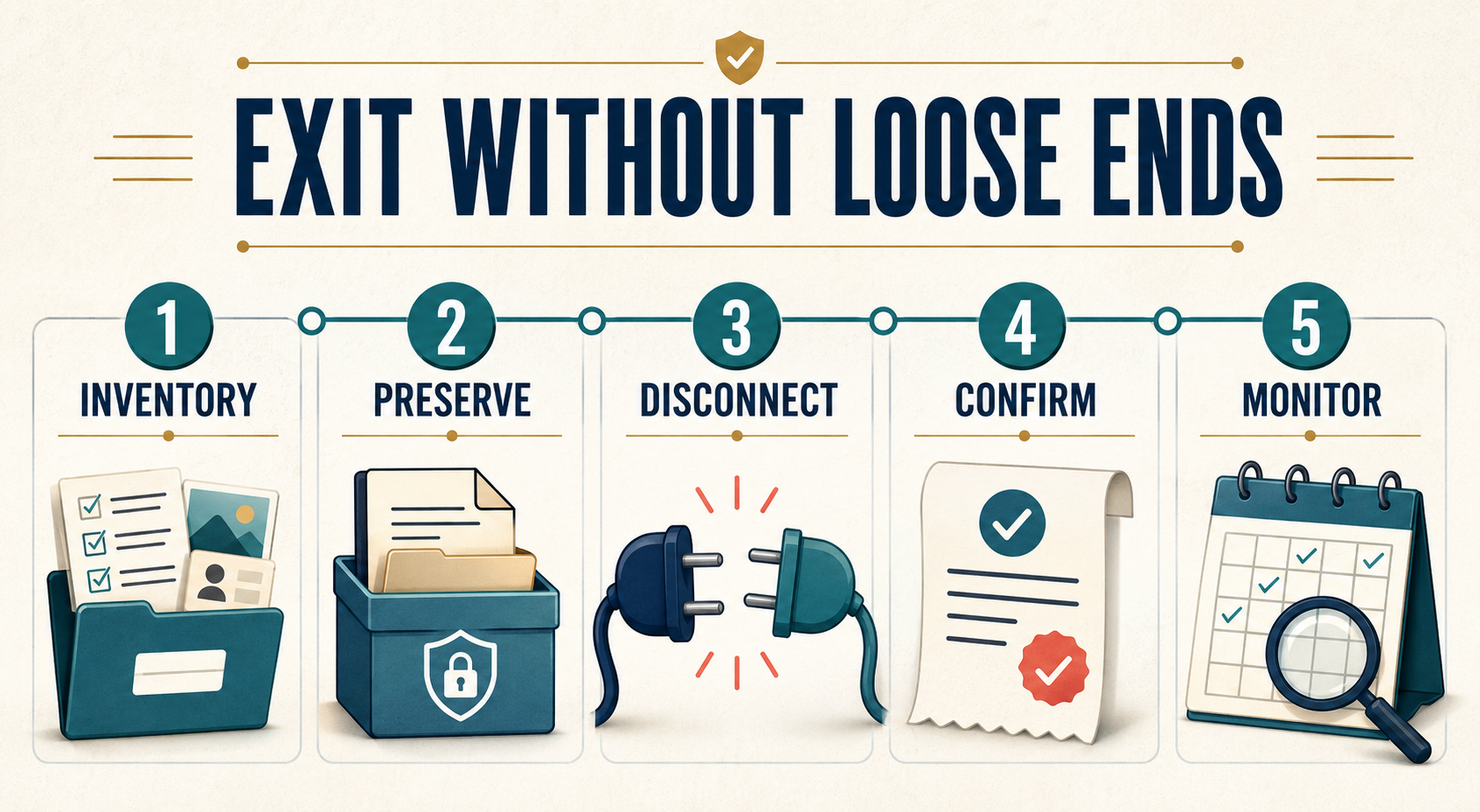
A strong offboarding article puts reversible preparation before irreversible action. The order is the value: inventory and preservation happen before credentials are revoked, access ends, or the account is deleted.
Infographic: a safe exit closes dependencies only after the reader has preserved and verified what still matters.
-
Inventory the Relationship—not Merely the Subscription
Begin with the job the reader must still be able to do after leaving. “Cancel the tool” is an action. “Keep every published page available, preserve editable source files, retain the domain, and stop the next renewal” is an offboarding scope.
Ask the guide writer to inspect five layers:
- Work: content, media, templates, project files, reports, exports, notes, and saved research.
- Access: account owners, team members, recovery routes, roles, licenses, and shared workspaces.
- Connections: domains, email, analytics, APIs, social accounts, webhooks, plugins, automations, and payment tools.
- Commitments: renewal dates, billing cycles, notice periods, plan changes, credits, and remaining service access.
- Evidence: current terms, official instructions, support contact, review date, and non-sensitive confirmation records.
Checkpoint: the reader can explain what must survive, what must stop, and what can remain unchanged.
-
Preserve and Verify Before Access Changes
“Export complete” is not enough. The guide should tell the reader where the export was saved, which formats it contains, what the export excludes, and how to test a representative file outside the old platform.
A screenshot may preserve a reference but not an editable asset. A downloaded archive may exist but still omit linked media, comments, versions, metadata, automation rules, or account-only reports. Use the merchant’s current documentation to describe known limits, and label any personal test by date, plan, device, or version.
Do not encourage readers to download or retain personal data they do not have a legitimate reason to keep. The planner below is for non-sensitive project details, not private account contents.
Checkpoint: one representative asset opens and remains useful without relying on the access that is about to end.
-
Disconnect in Dependency Order
Integrations should not be removed randomly. A publishing connection may still be needed to export a final asset. A domain or email setting may affect a live website. A team member may own a file or integration that the primary reader cannot transfer alone.
Show a conservative sequence: finish the final supported task, confirm ownership, preserve the necessary output, document the current connection, remove dependent automations, revoke unneeded permissions, and then verify the remaining system still performs its essential job.
Credentials, tokens, domain settings, billing methods, and private account roles should be handled through official interfaces. An independent affiliate publisher can explain the decision sequence without requesting the reader’s secrets.
Checkpoint: every connection has a keep, transfer, remove, or official-support decision—and a named time to act.
-
Confirm the Official Exit and Its Effective Date
Use the merchant’s current account settings, cancellation documentation, terms, privacy information, or support page. State when the source was reviewed. Explain whether the documented action stops renewal immediately, ends paid access at a future date, returns the account to a free tier, or begins a separate deletion process.
Confirmation should be useful without exposing private information. A reader may record the date submitted, the official route used, the effective date shown, a case or confirmation number stored privately, and the next expected account state.
Do not tell readers that canceling will produce a refund unless the current policy and their situation support it. Do not treat a pending request as completed.
Checkpoint: the reader can identify what the merchant confirmed, when it takes effect, and what access or obligation remains until then.
-
Monitor the Handoff Until the Evidence Matches
A good guide schedules one or more appropriate follow-up checks instead of ending at the button click. The reader may need to confirm that the next renewal did not occur, the old integration is inactive, the promised access change happened, a domain or file remains available elsewhere, or a separate data request received a response.
If the observed result does not match the confirmation, move to the official support route with the non-sensitive timeline already organized. Avoid advising public accusations, repeated account actions, or payment disputes as a generic first step. The merchant and the reader’s payment provider control account-specific processes.
Checkpoint: the final account, billing, access, and connection states match the documented plan—or the unresolved item has been handed to the correct official channel.
“Cancel,” “Close,” and “Delete” Are Not Interchangeable
Interface labels vary, and each merchant defines its own process. An offboarding guide should state the intended result instead of assuming that one button completes every exit task.
| Action | Usually aims to do | Does not automatically prove | Best source |
|---|---|---|---|
| Turn off renewal | Prevent a future subscription period from beginning. | That current paid access ends immediately, the account is deleted, or a refund is due. | Current billing settings and subscription terms. |
| End a paid plan | Stop paid features at the documented effective time. | That free access, hosted assets, domains, or retained data disappear. | Official plan, cancellation, and access documentation. |
| Delete an account | Begin the merchant’s process for closing the account. | Immediate removal of every record or release from legal retention duties. | Official account and privacy instructions. |
| Remove stored data | Request the data handling available under the merchant’s policy and applicable rules. | That the subscription is canceled or all backups disappear immediately. | Current privacy policy or authenticated privacy request route. |
| Request a refund | Ask the merchant to review an account-specific payment issue. | Approval, timing, or cancellation of future renewal. | Current refund policy and official billing support. |
Preserve First
Files, ownership, licenses, URLs, and working evidence that the reader will need after the old access changes.
Verify Officially
Renewal, effective dates, remaining access, plan changes, deletion routes, and current merchant policies.
Stop and Escalate
Unexpected charges, identity checks, private account access, security incidents, refunds, or merchant-controlled errors.
Infographic: sort offboarding work by preservation need and control boundary—not by the order of buttons on the account page.
Define “Finished” Before Writing the Exit Steps
An offboarding article becomes safer when the completion rule is written first. Otherwise, the guide may stop at the visible cancellation button while the important dependencies remain invisible.
| Weak checkpoint | Reader-first replacement | Evidence to show |
|---|---|---|
| “Your subscription is canceled.” | State whether renewal stopped, when paid access ends, and what account state follows. | Official terms, effective date, confirmation route, and review date. |
| “Download your files.” | Inventory the needed assets, export them, and open a representative sample independently. | Formats, exclusions, saved location, and a successful verification. |
| “Disconnect everything.” | Remove connections in dependency order after ownership and exports are confirmed. | Connection purpose, owner, remove date, and remaining-system test. |
| “Delete the account for privacy.” | Separate subscription cancellation from the merchant’s account and data processes. | Current privacy instructions and official authenticated request route. |
Google’s people-first content guidance asks whether a page provides substantial value and leaves readers feeling they learned enough to achieve their goal. An offboarding guide adds that value when it explains sequence, dependencies, exceptions, and confirmation—not when it paraphrases a cancellation screen.
Practical Example: Leaving a Hosted Affiliate-Business Platform
Imagine a publisher has used one platform for training, websites, research, drafts, community access, and recurring membership. A weak article says, “Click cancel, then join my preferred alternative.” A reader-first guide first defines what the reader must preserve and which services are actually attached to the account.
- Inventory: list hosted websites, domains, drafts, media, research notes, membership dates, owners, and third-party connections.
- Verify the current terms: use the platform’s official terms, pricing, account settings, and support pages—not an old screenshot or another affiliate’s memory.
- Preserve and test: move or export what must survive, confirm ownership, and verify the destination before changing old access.
- Disconnect deliberately: handle domains, plugins, analytics, automations, team roles, and credentials in dependency order.
- Confirm the exit: record the official result, effective date, remaining access, and any separate account or data step.
- Monitor: check that the account and billing states eventually match the confirmation.
For a current, concrete example, Wealthy Affiliate’s official Terms of Service, last updated March 3, 2026, state that subscriptions renew unless canceled before the next billing cycle, cancellation is available through account settings, and cancellation takes effect at the end of the current billing period. The same terms say subscriptions are generally non-refundable for the period they cover and direct specific billing concerns to support. The official contact page includes a billing category.
Optional New-Platform Fit Check—Only After the Exit Is Stable
A new affiliate recommendation belongs only when the reader has a genuine destination decision. If a beginner is leaving a disconnected collection of training, hosting, research, and support tools—and specifically wants those functions in one environment—Wealthy Affiliate may be worth inspecting as one option. Its official pricing page currently lists a free Starter plan with no credit card required, one limited website, starter access, and an allocation of AI credits. Features, limits, and prices can change, so verify the current plan details.
This is a fit test, not a required ending. The reader may choose separate tools, another platform, a pause, or no replacement. A free account should not be used as an excuse to move a valuable live asset before the destination has been tested.
Affiliate disclosure: The following link is an affiliate link. OnlineAffiliate.net may earn compensation if you join or later purchase through it, at no additional cost to you. Training, hosting, tools, AI assistance, and community support do not guarantee traffic, rankings, commissions, profitability, or income.
Explore Wealthy Affiliate’s Current Starter Experience
The Federal Trade Commission’s Endorsement Guides Q&A explains that material connections should be disclosed clearly and conspicuously, with the disclosure close to the recommendation. That remains true in exit content: a late-page replacement link is still an affiliate endorsement.
Write the Guide So the Reader Can Audit It
Offboarding steps age quickly. Make the scope and evidence visible so the reader can distinguish a current, tested path from a general planning framework.
- Exact environment: product, plan, billing cycle, region, account role, and connected services when they change the path.
- Review date: state when cancellation, export, access, privacy, and support instructions were checked.
- Evidence source: distinguish official documentation, your transparent test, and reader-reported experience.
- Preservation scope: name what must survive and how a representative item was verified.
- Connection order: show which dependency must remain until another task is complete.
- Effective date: explain when the documented account or plan change should occur.
- Known exceptions: identify plan, contract, role, ownership, region, format, or privacy differences.
- Support boundary: send private billing, refund, identity, security, deletion, and account issues to the official route.
- Commercial relationship: disclose any replacement recommendation before the affiliate link.
Build Your Affiliate Offboarding Guide Plan
Use the planner before drafting. It turns “cancel the tool” into a controlled exit for one reader and one defined account relationship. Entries stay in this browser when local storage is available.
Affiliate Offboarding Guide Planner
Privacy reminder: Do not enter passwords, account numbers, invoices, payment details, recovery codes, access tokens, customer information, private support messages, or confidential files.
Run the Draft Through the P.R.O.O.F. Content Test™
The site’s P.R.O.O.F. test keeps an offboarding article useful even when the replacement affiliate link earns nothing.
Add a Maintenance Trigger
Review a product-specific offboarding guide whenever the merchant changes its pricing, renewal language, export options, account settings, ownership rules, privacy process, support routes, or access after cancellation. Review it again after readers report a recurring mismatch. Do not update the visible date unless the guide has been meaningfully checked and improved.
Where Internal, External, and Affiliate Links Belong
- Link backward to reassessment. Readers who have not decided to leave still need a fair stay, change, wait, or exit decision.
- Link sideways to migration. When assets must reach a destination, the move needs its own verified workflow.
- Link to current official sources. Exports, renewal, access, cancellation, refunds, privacy, and support belong with the organization that controls them.
- Link to official support at the private boundary. Do not imitate authenticated customer service inside a public article or comment thread.
- Use an affiliate link only at a genuine destination decision. Disclose the relationship, explain fit and limits, and preserve noncommercial outcomes.
Four-Question Knowledge Check
Can you separate a responsible offboarding guide from a cancellation shortcut and a replacement sales pitch?
Frequently Asked Questions
What is an affiliate offboarding guide?
It is a reader-first article for the stage after someone decides an old product, plan, account, or platform relationship should end. It helps the reader preserve needed work, close dependencies, use official exit routes, and verify the final state without promising an account-specific result.
Is an offboarding guide the same as a migration guide?
No. A migration guide focuses on moving important work to a supported destination. An offboarding guide focuses on safely ending the old relationship. A reader who switches may need both, with destination verification completed before the old path closes.
Should an affiliate publisher tell readers to cancel a product?
The publisher can explain evidence and decision criteria, but should not assume every reader has the same needs, contract, billing cycle, or account conditions. A reassessment guide should support the decision first. The offboarding guide begins after the reader has a defensible reason to leave.
Should an offboarding guide include screenshots?
Use screenshots only when interface location or wording materially helps. Remove private details, add descriptive alternative text, identify the plan or version when relevant, and state the review date. Prefer outcome-based instructions because interfaces and labels change.
Does canceling a subscription delete the reader’s data?
Not necessarily. Subscription, account, access, and data processes may be separate. Link to the merchant’s current official instructions and privacy information, and send account-specific questions through the authenticated privacy or support route.
Can an offboarding guide contain affiliate links?
Yes, when a link supports a genuine next-platform decision and the compensation relationship is obvious. The guide should remain complete when the reader chooses another option, returns to separate tools, pauses the project, or buys nothing.
A Trustworthy Recommendation Has an Exit
Inventory the relationship. Preserve and verify what matters. Disconnect in dependency order. Confirm the official result and effective date. Monitor until the evidence matches. If a destination is involved, complete the migration plan before the old recovery window closes.
Where Does Your Reader Find the Loose End?
Choose one product category your audience uses. Which file, renewal, connection, permission, access date, or account-state question makes leaving confusing?
Share the product category and the non-sensitive offboarding question in the comments. Please leave out account names, email addresses, invoices, payment details, passwords, recovery codes, tokens, private screenshots, support case contents, and customer information. Your example may reveal the next exit guide another publisher needs.
Fact-check note: OnlineAffiliate.net internal links, Google Search Central guidance, FTC endorsement guidance, the Wealthy Affiliate pricing, terms, contact, and user-supplied tracking URLs were reviewed on August 31, 2026. Product interfaces, plan limits, prices, exports, access rules, billing terms, privacy processes, support routes, and policies can change. Verify time-sensitive details before publishing and during scheduled refreshes.
