If I had $0 to start an affiliate website in 2027, I would not spend January shopping for tools. I would spend it answering one question: can I build something useful enough that a real person would want to read it?

No premium theme. No paid keyword tool. No advertising. Just a laptop, a notebook and the willingness to finish something before buying something.
The goal is not to look like an online business on day one. It is to discover whether you can do the work.
If I were starting an affiliate website from scratch in 2027, I would spend my first month proving that I could create something useful before spending money trying to make it profitable.
Here is the four-week plan I would follow, including what I would make, what I would measure and exactly when I would consider spending money.
Affiliate disclosure: OnlineAffiliate.net may earn a commission or receive other affiliate benefits if you register through our Wealthy Affiliate referral link and complete qualifying actions or purchases. This does not increase your purchase price. Income and traffic are not guaranteed.
My Three Rules for Starting an Affiliate Website With $0
The temptation to buy tools often arrives before you have identified the problem those tools are supposed to solve.
I would reverse that process.
Rule 1: Start With a Reader, Not a Product
Instead of asking which affiliate program pays the highest commission, ask who needs your help and what decision they are struggling to make.
A website about fishing equipment is broad. A website helping families choose affordable equipment for bank fishing has a clearer purpose.

The narrower question gives you something useful to write about immediately.
This is a useful distinction when working across different niches. A fishing site, an air purifier guide and a 3D printing service may cover unrelated subjects, but each can begin with the same editorial question: what decision is the reader trying to make today?
Rule 2: Finish Something Before Buying Something
Complete an article, a comparison or a practical guide before purchasing another subscription.
Finishing one useful page teaches you more about your actual publishing needs than collecting ten tools you have not learned to use.
Rule 3: Measure Progress Before Measuring Income
Your first month is a test of your ability to research, explain, publish and improve.
Revenue matters, but expecting immediate commissions can lead to rushed recommendations, unnecessary expenses and disappointing results.
The $0 Affiliate Website Challenge: Your First 30 Days
Set aside approximately 30 to 60 minutes on the days you can work. Adjust the schedule to fit your responsibilities. Missing a day does not mean you have failed.
Week 1 · Days 1–7
Find Your Reader
Choose an audience, identify three real questions and draft your first helpful answer.
Milestone: One finished draft.
Week 2 · Days 8–14
Build Your Foundation
Try a practice website, create simple navigation and publish or preview your first page.
Milestone: One working page.
Week 3 · Days 15–21
Create a Content Cluster
Write two supporting articles that answer related reader questions.
Milestone: Three connected pages.
Week 4 · Days 22–30
Review and Decide
Improve your articles, assess your workflow and identify any genuine limitations.
Milestone: An informed next step.
Week 1: Choose a Problem Worth Solving
Your first niche does not need to be your lifelong passion. It needs to be a subject you can research responsibly and explain clearly.
Open a notebook and complete these three sentences:
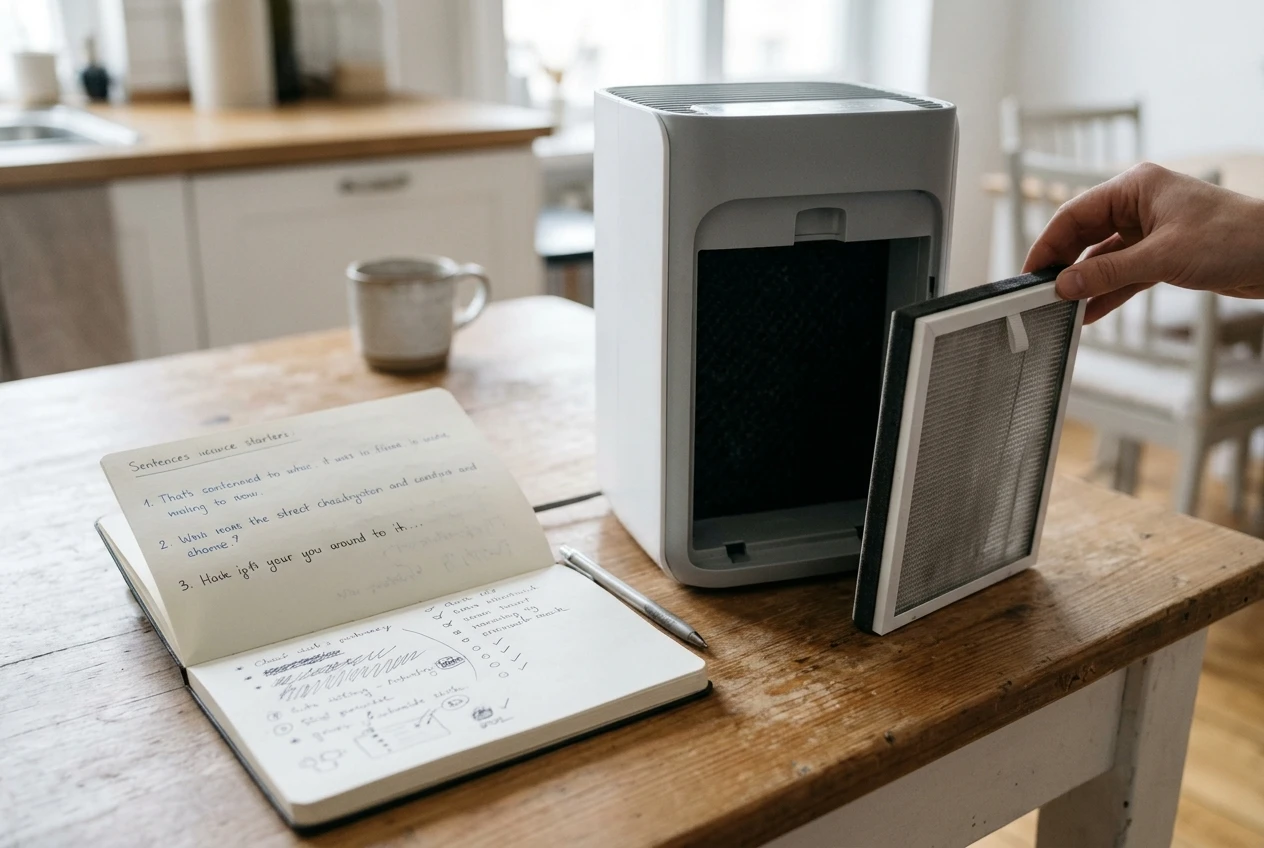
- I want to help people who…
- They often struggle with…
- I could help them make a better decision by…
Here is an example:
Audience: Apartment residents interested in cleaner indoor air.
Problem: They do not understand which replacement filter fits their air purifier.
First article: How to Find the Correct Replacement Filter Without Buying the Wrong One.
You now have an identifiable audience, a specific problem and a useful article idea. You do not need an affiliate link to begin writing it.
Use our 7-Day Affiliate Fit Check to organize your first week.
Days 1–2: Define one reader and collect three questions.
Days 3–4: Choose one question and check reliable sources.
Days 5–6: Draft a clear answer.
Day 7: Revise it for someone who has never encountered the subject.
Finish line: One useful draft, not a purchased domain.
Week 2: Build Something You Can Actually Use
A professional-looking website is not the first goal. A functional website that helps a reader is.
I would create a simple homepage, a draft About page and one useful article. Before publicly promoting affiliate offers, I would also prepare the appropriate privacy information and affiliate disclosures.
Keep your navigation simple. Check that your text is readable on a phone. Learn how to edit a paragraph, insert a link and preview an article.
Those basic tasks are more important right now than sophisticated design.
Not sure which website builder to use? Follow our beginner website builder guide to test how easily you can make an actual edit.
Create a page, save it, reopen it the next day, correct a sentence and preview the correction on your phone.
If the free platform cannot publish publicly, keep a copy of the draft and use its preview feature.
Week 3: Create Three Articles That Work Together
One common beginner mistake is publishing unrelated articles because each appears to have attractive search potential.
Instead, build a small collection of pages that help the same reader.
For example, a website about affordable beginner fishing equipment might publish:
- How to Choose Your First Spinning Reel.
- Why Your Fishing Line Keeps Tangling.
- What Fishing Rod Length Works Best From the Bank?
Each article answers a different question. Together, they help a beginner become more confident.
Connect the articles with relevant internal links so readers can continue learning without having to search for another website.
Our guide to writing your first useful affiliate page for $0 can help you develop each article.
Article 1 helps a reader choose. Article 2 helps them fix a common problem. Article 3 helps them use what they chose.
Link the pages where each next step genuinely helps.
Week 4: Find the Bottleneck
By the fourth week, you may discover that your biggest problem has nothing to do with software.
Perhaps you struggle to find focused article ideas. Maybe your writing takes longer than expected, or you are uncertain about explaining product differences accurately.
Those are useful discoveries.
Before buying anything, identify the specific task that is slowing you down. Then determine whether practice, free training or a paid tool is the most appropriate solution.
Check one page for an unclear answer, an unsupported claim, a broken link and awkward mobile formatting. Fix those before researching another subscription.
Your First 30 Days Are About Building Assets
Even if you earn nothing during the challenge, you can finish the month with something valuable:
- A clearly defined reader and niche.
- A repeatable research and writing process.
- Three connected, useful articles.
- Experience using a website editor.
- A list of genuine reader questions.
- A better understanding of which tools you actually need.
These are foundations for an online business, not guarantees that the business will succeed.
Your 30-Day Progress Tracker
Check off each milestone as you complete it. You can print this section or copy the tasks into your own notebook. Checks may reset when the page reloads.
My day-30 evidence: What did I finish? What did I learn? What task still needs help?
What Would I Use for Free?
You do not need a separate subscription for every task. Here is how I would approach the first month.
| Task | Free Starting Point | When Paid Tools May Help |
|---|---|---|
| Niche research | Public search results, reader questions and personal knowledge | When deeper research becomes necessary |
| Writing | A free document editor or notebook | When an established workflow needs greater efficiency |
| Website building | A free practice website | When you need your own domain or more control |
| SEO | Google Search Central and basic on-page optimization | When a specific technical SEO need emerges |
| Images | Your own photographs and properly licensed free images | When specialist imagery becomes necessary |
| Performance measurement | A spreadsheet and Google Search Console on an eligible verified site | When more detailed reporting is justified |
Use Google’s people-first content guidance as a starting point for SEO education.
Remember that purchasing an SEO plugin does not guarantee rankings, and subscribing to an AI writing tool does not automatically produce trustworthy content.
Where Does Wealthy Affiliate Fit Into This Plan?
There are two sensible ways to begin this challenge.
The Independent Route
Use your own documents, free resources and a website platform of your choice.
Best for: People who enjoy assembling their own tools and learning independently.
The Guided Route
Use Wealthy Affiliate Starter to explore an integrated environment for planning, learning and experimenting with a practice website.
Best for: Beginners who prefer a structured starting point.
As of November 28, 2026, Wealthy Affiliate’s public Starter plan lists:
- A free account with no credit card required.
- One practice website.
- 4,000 initial AI credits.
Starter is a limited environment. Paid plans provide additional capacity and features. Review the current official membership comparison before making any purchasing decision.
Give Your Idea a Place to Grow
You do not have to decide whether affiliate marketing is right for you before trying it.
Bring one audience, one reader question and one article idea to a free Starter account. Explore the workflow and decide whether it helps you make progress.
Affiliate disclosure: We may receive compensation from qualifying referrals or purchases through the following link.
Explore Wealthy Affiliate Starter — $0
No credit card required for Starter. An upgrade is not necessary to begin exploring the platform.
Already created your free account? Follow our first 24 hours inside Wealthy Affiliate guide instead of wondering what to do next.
When Would I Finally Spend Money?
I would consider spending money when three conditions are met.
- I know what I am building. My website has a defined audience and purpose.
- I have established a routine. I can complete useful articles and improve them regularly.
- I can explain the limitation. A particular tool or platform restriction prevents me from doing something important.
For example, registering a domain may make sense when you are ready to commit to a website identity. Paid hosting may become necessary when you need greater control over your website.
A paid SEO plugin may eventually help with advanced website optimization, but a beginner does not need one simply because an affiliate marketer recommends it.
The Subscription Test
Before purchasing any tool, finish this sentence:

I need this subscription because it will help me complete ________, which I cannot reasonably accomplish with my current tools.
If you cannot fill in the blank, postpone the purchase.
Modern SEO Starts Before You Open an SEO Plugin
Search engines and AI-powered discovery systems give publishers more ways to reach readers. However, no particular optimization method guarantees that your content will appear.
I would concentrate on five publishing habits:
- Answer a specific question early in the article.
- Use clear headings and practical examples.
- Include relevant original observations and images.
- Distinguish firsthand experience from information gathered through research.
- Update outdated information and link to reliable sources.
Google’s Discover guidance also encourages accurate, non-clickbait headlines and compelling, relevant images.
Write articles that deserve to be discovered rather than chasing a formula that promises visibility.
Your Day-30 Decision
At the end of the challenge, review your progress. You do not have to upgrade, and you do not have to continue if the work is not a good fit.
Continue for Free
You enjoy the work, but your existing tools still meet your needs.
Consider an Upgrade
You have a repeatable routine, a specific limitation and an affordable budget.
Adjust Your Niche
You enjoy creating content, but your original audience or topic is not a good match.
Choose Another Direction
The work is not right for you. Learning that before purchasing subscriptions is a valuable outcome.
Knowledge Check: Are You Ready to Start?
Select each question to reveal the answer.
1. What should you choose first: a profitable affiliate program or a specific reader problem?
Answer: A specific reader problem. It gives you a reason to publish useful content and helps you evaluate affiliate programs based on reader needs.
2. Do you need a paid website subscription before writing your first article?
Answer: No. You can research and draft content using free tools before deciding how to publish it.
3. What is a reasonable measure of first-month progress?
Answer: Finished articles, a functioning practice page, clearer audience understanding and a repeatable workflow. Income is not guaranteed.
4. When should you consider buying an SEO tool?
Answer: When you can identify a genuine SEO task or limitation that the tool addresses and justify its cost.
Frequently Asked Questions
Can I start affiliate marketing with no money in 2027?
Yes. You can begin researching, writing and experimenting with free publishing tools. Domain registration, professional hosting and other business expenses may arise as your website develops.
Do I need to purchase products before becoming an affiliate?
Not necessarily. Educational guides and comparisons based on reliable research can help readers without requiring every product to be purchased. Never claim to have personally tested a product unless you actually have.
Can I earn commissions during my first 30 days?
It is possible, but there is no dependable income timeline. You may need additional content, an audience and affiliate program approval before earning anything.
Is Wealthy Affiliate Starter really free?
The public Starter plan currently lists a $0 account without a credit card requirement. Features are limited, and optional upgrades cost money. Confirm the current terms before joining.
Do I need AI to start an affiliate website?
No. AI can assist with organization, brainstorming and editing, but it is not a requirement. You remain responsible for the accuracy, originality and usefulness of published content.
How many articles should I publish in my first month?
Three useful, connected articles are a reasonable challenge target, not an SEO requirement. Adjust your publishing pace to your experience, available time and ability to maintain quality.
When should I add affiliate links?
When a recommendation genuinely helps readers and you have permission to participate in the relevant affiliate program. Clearly disclose your financial relationship before or alongside the recommendation.
My Final Thought: Start Small Enough to Finish
If I were beginning again in 2027 with a zero-dollar budget, I would not try to build an entire online business in one weekend.
I would find one person with one problem and write something that helps.
Then I would do it again.
Over time, those individual articles could become a useful website, a recognizable resource and potentially a source of affiliate income.
The first step does not require an expensive subscription.
It requires a question worth answering.
What Will You Build With Your First 30 Days?
Start with one idea. Explore the tools. Decide whether affiliate marketing fits your goals before making a financial commitment.
OnlineAffiliate.net may receive compensation from qualifying referrals or purchases through this link.
Let’s Talk in the Comments
If you had $0 and 30 days to build your first affiliate website, what subject would you choose?
Would it be a hobby, a professional skill, a problem you have solved or something completely new?
Share your day-one idea in the comments:
My reader is ___. Their problem is ___. My first article will answer ___.
You do not need a perfect niche to join the conversation.
Continue Your Learning Journey
- Take the 7-Day Affiliate Fit Check
- Learn How to Start an Affiliate Website for Free
- Write Your First Useful Affiliate Page
- Find a Beginner-Friendly Website Builder
- Your First 24 Hours Inside Wealthy Affiliate
Editorial and verification note: This article presents a proposed beginner challenge, not a documented income experiment. Wealthy Affiliate membership details were checked against its official pricing page on November 28, 2026. Features and terms may change.
Additional resources: FTC endorsement and affiliate disclosure guidance and Google Search Central helpful content guidance.
OnlineAffiliate.net — Helping beginners build their first online business without wasting money on tools they don’t need.
