Affiliate Marketing for Beginners • 2026
Five Connected Posts Beat Fifty Disconnected Ideas
You chose an audience. You opened a website. You may even have a long list of keywords. Yet the next question can stop a new affiliate marketer cold: What should I publish first?
Do not fill the site with random product posts. Build a short reader path that helps one person recognize a problem, understand it, compare choices, take action, and get a better result.
Quick Answer
What Should a New Affiliate Website Publish First?
Plan five connected posts for one audience: a problem-discovery post, a clear explainer, a fair comparison, a step-by-step action guide, and a troubleshooting or improvement guide. Link them in both directions so readers can move to the next useful answer without returning to search.
Your first goal is not to cover the entire niche. It is to prove that you can build one small, useful path and then improve it.
This is the natural next step after deciding what to do in your first 24 hours inside Wealthy Affiliate and protecting a realistic five-hour weekly work block. You have a direction and time on the calendar. Now those hours need a connected publishing plan.
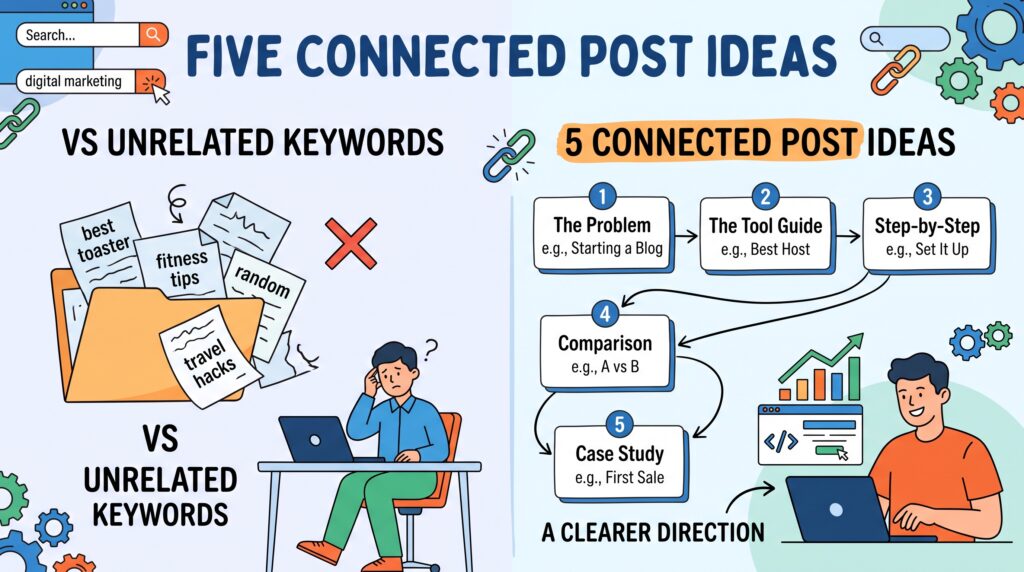
Why Random Posting Makes a New Site Feel Harder
A keyword list can look like a content plan even when every idea serves a different reader. One post targets beginners, another targets experts, a third chases a high commission, and the fourth answers a question that has nothing to do with the first three.
The result is not only confusing for visitors. It is confusing for the person building the site. Every article requires a fresh audience, research process, vocabulary, and set of products.
Google’s people-first guidance asks whether a site has an intended audience, a clear focus, and content that leaves a reader feeling they learned enough to reach a goal. A five-post reader path gives you a practical way to apply those principles without pretending that five posts guarantee visibility. Read Google’s people-first content guidance.
Your Five-Post Reader Path
Think of these as five jobs rather than five rigid article formats. The exact titles will change with your niche, but the reader’s movement stays useful.
Help the reader recognize what is happening and why it matters.
Clarify the factors, terms, and trade-offs that shape the answer.
Show who each realistic option fits—and who should avoid it.
Walk the reader through a focused setup, task, or decision.
Troubleshoot, improve, or reassess what happened next.
Visual map: one audience moves through five related needs instead of landing on five isolated articles.
Publish the Problem-Discovery Post
This page helps a reader recognize a symptom, frustration, or decision. It should answer, “What is going on, and what should I pay attention to first?”
Do not rush to a product. Give the reader a diagnostic starting point, explain the most likely causes, and show when the problem needs a different kind of help.
Publish the Clear Explainer
Now explain the few concepts that genuinely change the answer. Translate unfamiliar terms, show cause and effect, and separate important variables from distractions.
A good explainer makes the later comparison more useful because the reader understands what the specifications or features actually mean.
Publish the Fair Comparison
Compare two or three realistic paths. Use criteria that matter to this audience, not a feature dump. Say what each option does well, what it costs in money or effort, and when neither option is a good fit.
This is often where a recommendation can begin to earn its place. The comparison must remain useful even if the reader never clicks an affiliate link.
Publish the One-Result Action Guide
Help the reader complete one visible task. State the starting point, the finish line, the necessary steps, and the safe stopping points. Avoid turning a beginner guide into an encyclopedia.
The strongest action guide lets the reader see progress before asking them to buy another tool.
Publish the Troubleshooting or Improvement Guide
Do not abandon the reader after the first attempt. Help them identify what went wrong, make one controlled change, and decide whether to continue, adjust, switch, or ask for support.
This post is valuable even when the reader already bought something elsewhere. That is exactly why it can build long-term trust.
Random Posts vs. a Product-First Site vs. a Reader Path
| Launch approach | Immediate appeal | Main weakness | Best next move |
|---|---|---|---|
| Random keyword posts | You can start with whichever idea looks easiest. | The pages may serve different people and never support one another. | Choose one audience and reorganize the strongest ideas into a path. |
| Product-first posts | The monetization opportunity is obvious. | Recommendations can appear before the site has earned context or trust. | Add problem, explainer, use, and support content around the decision. |
| Five-post reader path | Every page has a role and a logical internal link. | It requires you to narrow the audience before publishing. | Complete one path, review what readers still need, and expand carefully. |
How to Choose the Five Topics Without Chasing Search Volume
Search data can help you understand language and demand. It cannot tell you whether you can produce the best answer for your intended reader.
Use this filter before adding an idea to the map:
- Same reader: Would the same person reasonably need this page?
- Visible outcome: Will the reader understand, choose, fix, avoid, or complete something?
- Evidence: Can you support important claims with primary sources, direct experience, testing, or clearly identified limits?
- Useful difference: Can you add a better example, comparison, decision rule, photograph, measurement, or explanation?
- Natural handoff: Is there a relevant next page in your five-post path?
Where Wealthy Affiliate Fits Into This Five-Post Plan
You do not need Wealthy Affiliate to make this plan. A document, independent hosting, WordPress, research tools, and your own workflow can do the job.
The reason a guided platform may help a beginner is narrower: it can reduce the number of disconnected systems you must choose before you learn whether you enjoy building useful content.
As checked on September 20, 2026, Wealthy Affiliate’s official pricing page lists its Starter plan as free with no credit card required. It currently includes 4,000 one-time AI credits, one limited website, standard AI models, limited support for seven days, and access to Phase 1 strategy material. Features and limits can change, so verify the current official pricing page before joining or upgrading.
| Your situation | Reasonable path | What to test |
|---|---|---|
| You are unsure whether you want to write these five posts. | Plan in a free document first. | Whether one audience produces five real, connected needs. |
| You want to experience a guided website and training workflow. | Test the free Starter environment. | Whether the connected tools make the next action clearer. |
| You finished useful work and reached a specific free-plan limit. | Compare the paid plan with a DIY stack. | Whether the feature that removes the limit is worth its ongoing cost. |
Want to Test the Five-Post Workflow in One Place?
Use the free account to inspect the training, choose one audience, and begin mapping the five reader needs. Judge the platform by the useful work it helps you finish—not by a promised income result.
Explore Wealthy Affiliate Free Compare DIY vs. Wealthy AffiliateThe first button is an affiliate link. OnlineAffiliate.net may receive compensation if you later purchase a qualifying membership. No traffic, ranking, commission, or income result is guaranteed.
Connect the Posts Before You Publish Them
Internal links work best when they continue the reader’s task. Add them because the next page answers the next question—not because an SEO checklist demands a certain number.
- The discovery post should link to the explainer and the action guide.
- The explainer should link to the comparison when the reader is ready to evaluate options.
- The comparison should link back to the explainer for context and forward to the action guide.
- The action guide should link to the troubleshooting page before common problems appear.
- The troubleshooting page should link back to the exact setup or decision step that may need correction.
Also leave room to say, “This option is not a fit.” An honest poor-fit statement is more useful than forcing every reader toward the same product.
Your Interactive Five-Post Launch Planner
Define the audience once, draft one working title for each role, and mark each page when its outline is ready. Your entries and progress are saved in this browser.
0 of 5 outlines ready
Do Not Wait for Five Perfect Drafts
Plan all five, but publish them one at a time. The first page will teach you what the second page needs. The comparison may reveal a missing definition. The action guide may expose a troubleshooting question you did not anticipate.
If you only have a few hours each week, use the five-hour beginner schedule to move one page from question to published answer. If you have not tested the platform yet, work through the free Starter plan evaluation before paying for more access.
Disclose the Relationship Before the Recommendation
If a post contains an affiliate recommendation, explain the financial relationship in plain language where the reader can notice it. A permanent disclosure page supports transparency, but it does not replace a clear disclosure in the article.
The Federal Trade Commission says affiliate relationships should be disclosed clearly and conspicuously, and that placing the disclosure closer to the recommendation is better. Read the FTC endorsement guidance.
Four-Question Knowledge Check
1. What is the main purpose of the five-post reader path?
2. When does a comparison become reader-first?
3. What should the fifth post do?
4. Does a free or paid platform guarantee traffic or income?
Answer all four questions, then check your score.
Frequently Asked Questions
Are five posts enough to make an affiliate website successful?
No fixed number of posts guarantees traffic, rankings, commissions, or income. Five connected posts are a manageable first publishing system. Use them to learn about the audience, practice the workflow, and identify the next useful question.
Should every one of the first five posts contain an affiliate link?
No. Add a recommendation only when it helps solve the reader’s existing problem. An explainer or troubleshooting page may be more useful without a commercial link. The entire path should remain helpful even when a reader buys nothing.
Which of the five posts should I publish first?
Usually begin with the problem-discovery post or the explainer. Either one establishes context for the comparison and action guide. If your audience already understands the problem clearly, the action guide may be the more useful starting point.
Do I need keyword research for the five-post plan?
Keyword research can reveal the language people use and related questions. It should support—not replace—audience understanding, trustworthy research, experience, and a useful answer. Do not select a topic only because a tool displays an attractive number.
Can AI write all five posts for me?
AI can help organize notes, compare outlines, surface missing questions, and improve clarity. You remain responsible for factual accuracy, firsthand value, fair recommendations, sources, disclosures, links, examples, and the final published wording.
Do I need Wealthy Affiliate to follow this plan?
No. You can build the path with your own hosting, WordPress installation, research tools, and training. Wealthy Affiliate is one integrated option for beginners who want to test training, a website environment, research assistance, AI tools, and support in one place.
When should I consider upgrading from a free plan?
Consider paying when you have decided to continue and can name the exact limitation blocking useful work. Compare the cost and feature with independent alternatives. Do not upgrade because you expect a membership level to create motivation or guarantee results.
Your First Site Does Not Need to Look Big
It needs to feel useful.
Choose one audience. Map five connected needs. Finish the first answer. Then make the handoff to the next page obvious.
If a guided environment would help you move from planning to publishing, you can explore Wealthy Affiliate free. If you prefer a DIY setup, use the same five-post map with your own tools. The platform is optional. The responsibility to help the reader is not.
What Are Your First Five Posts?
Share your niche and the one reader problem you want the site to solve in the comments. If you already have five ideas, list the one that feels hardest to place. Your question may become the next beginner guide on OnlineAffiliate.net.
Reviewed September 20, 2026. Wealthy Affiliate Starter details were checked against the official pricing page. Publishing guidance was checked against Google Search Central’s people-first and generative-AI documentation. Disclosure guidance was checked against the Federal Trade Commission. Platform features and terms can change after publication.
Sources: Wealthy Affiliate pricing • Google people-first content guidance • Google generative AI guidance • FTC endorsement guidance
